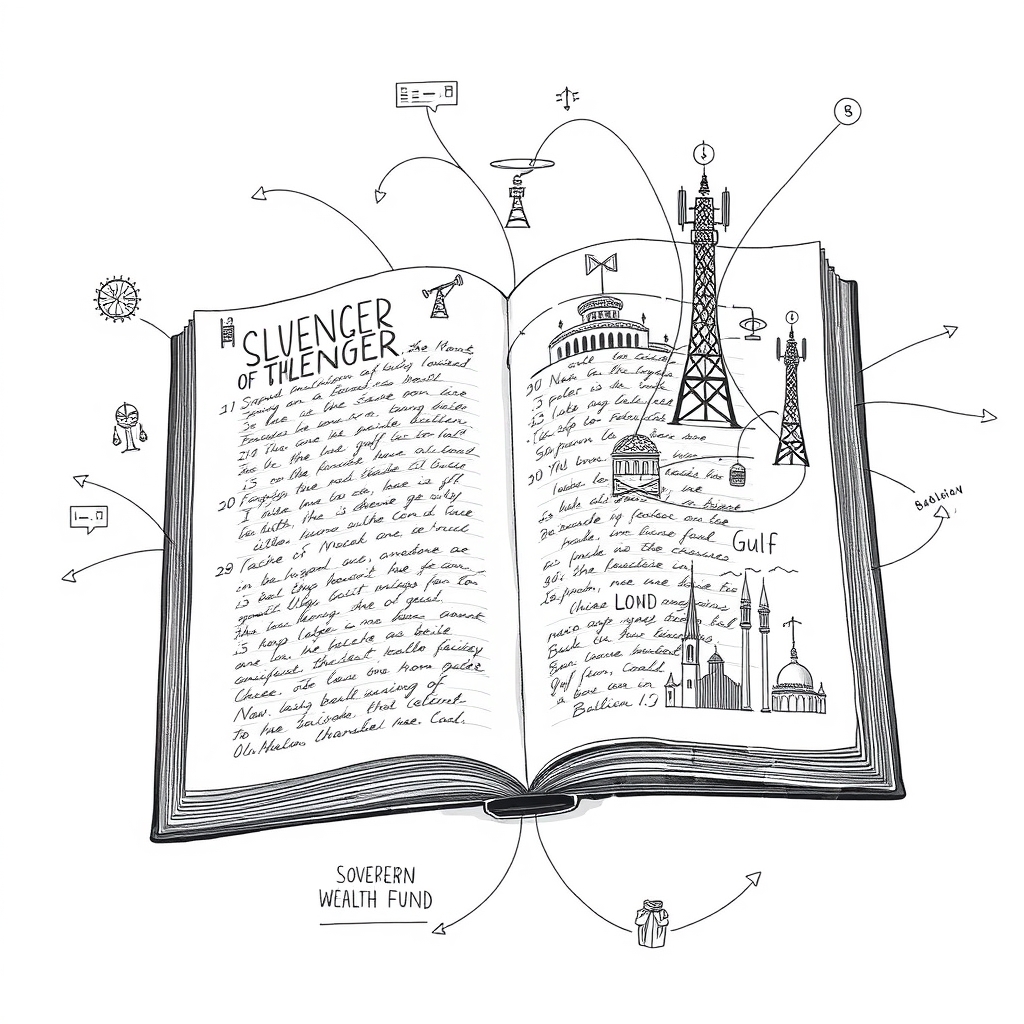
tart with a ledger. Not the familiar double-entry book of credits and debits, but a political ledger where favors are tender, time compounds like interest, and the asset being traded is the Republic's attention. In that ledger, Jared Kushner sits at the fulcrum—family to the president, consiglieri to sovereign money, and now a recurring name in deals that reach from Balkan riverfronts to American media sovereignties. Call it what you will: influence arbitrage, conflict inflation, soft capture. The form is unmistakable even when the actors insist it is merely business.
This is not an exercise in adjectives. It is an examination of structures: how post-office relationships are monetized, how law is skirted or rewritten, and how institutions are made porous to private appetites. We take Kushner as a method—because his deals are unusually well documented—and then widen the aperture to the Trump family, appointees, and billionaire allies.
The argument is simple. Under a presidency that treats the state as a platform, the border between public purpose and private profit becomes a negotiable seam. Where law is vague, relationships do the work; where law is firm, new entities and special statutes appear. The pattern is neither spectacular nor hidden. It is procedural, iterative, and lucrative.
I. The $3 Billion Proof
The canonical fact is now familiar: six months after leaving the White House, Jared Kushner's new private-equity firm, Affinity Partners, received a $2 billion commitment from Saudi Arabia's Public Investment Fund (PIF). What mattered was not merely the size or the timing, but the internal record: a PIF advisory panel raised concerns about Affinity's inexperience and high fees; the chair—Crown Prince Mohammed bin Salman—overruled them and approved the deal.
That was only the opening tranche. By 2024, Affinity had raised over $3 billion in total—the initial $2 billion from PIF, plus an additional $1.5 billion from Abu Dhabi's Lunate Capital and Qatar's QIA, according to Reuters' reporting on regulatory filings. Senate Finance Committee inquiries subsequently revealed that Affinity collected at least $157 million in management fees—compensation flowing to the fund's principals before any returns materialized for investors.
This is the blueprint. When public service ends, the rolodex becomes a term sheet; geopolitical alliances become limited partnerships; the familiar anti-corruption defenses (arm's-length, market-rate) appear in the press release as talismans. The Reuters and Axios coverage around that moment put the comparison in relief: Steven Mnuchin, Trump's former treasury secretary with deep markets experience, also secured roughly $1 billion from PIF for his new fund—yet it was Kushner, the political son-in-law, who secured the larger, more controversial check.
You can build an ethics curriculum from that juxtaposition alone.
The Clock: From Service to Sovereign Capital
| Date | Event | Significance |
|---|---|---|
| Jan 2021 | Kushner leaves White House | End of formal government service |
| Jul 2021 | Affinity Partners formed | Six-month gap—standard private-equity ramp |
| Apr 2022 | $2B PIF commitment announced | Internal PIF objections overruled by MBS |
| 2023-24 | $1.5B additional (Lunate, QIA) | Gulf sovereign trifecta completed |
| May 2024 | Belgrade lease signed | Balkan property expansion begins |
| Nov 2024 | Serbia lex specialis passed | Legislative carve-out for Kushner project |
| Early 2025 | Albania Sazan Island approval | Second Balkan strategic-investor status |
| Late 2025 | WBD/Paramount financing role | Media ownership arena entered |
The timeline is the argument: post-office relationships monetized within months, then leveraged into property and media positions within years.
II. The Balkans as Showcase: Law, Fast-Track, Tower
Kushner's post-office property push in the Balkans supplies the second act. In Serbia, Affinity-linked vehicles won a 99-year lease to redevelop the former Yugoslav army headquarters in central Belgrade, a landmark bombed by NATO in 1999 and protected as cultural heritage. Reuters detailed the lease in May 2024.
Protest followed. Parliament then debated—and in November passed—a special "lex specialis" to fast-track the project over preservation objections, a maneuver critics called a legal carve-out for a politically connected foreign developer. AP and The Guardian reported the bill's passage and leaked terms showing a state joint venture structured to Kushner's advantage.
That is the procedural signature: when an existing rule is in the way, draft the new rule. The case became a civics lesson in miniature—separation of powers strained, ministries accused of abuse, courts sidelined—captured by local and regional outlets tracking ministerial overreach and investigations into document tampering.
Albania provided the companion piece. Early in 2025, the government granted strategic-investor status to a Kushner-linked luxury resort proposal on Sazan Island, with tax preferences and a public joint entity to implement. Reuters chronicled approvals and the €1.4 billion scope; European press detailed environmental, heritage, and governance concerns.
The question is not whether development is allowed—it is whether law bends differently for the well connected. In both countries, politics did not follow investment; investment followed politics.
III. From Towers to Transmitters: The Media Front
Money seeks leverage. In late 2025 that leverage moved decisively into American media. The week's headlines told the story: a $108 billion hostile bid by Paramount Skydance to take Warner Bros. Discovery; financing reportedly including Affinity Partners and Gulf sovereign funds; and a parallel bidding war involving Netflix.
The deal's architects appear to be building a familiar kind of legal corridor: narrow enough to claim there is no foreign "control," wide enough for foreign capital to determine the outcome. Reuters documented the foreign equity's pledge to waive voting rights—a structure designed to argue there is no foreign control, and therefore no CFIUS review, despite foreign capital being decisive. The argument is procedural: no voting rights, no governance, no jurisdiction. Yet the concern raised by lawmakers is structural: when decisive money comes from abroad, influence doesn't need a ballot. It needs proximity, leverage, and time.
Representatives Liccardo and Pressley sent a letter urging regulators to scrutinize the arrangement, arguing that even non-voting foreign capital can shape the incentives of those who do vote. The question for regulators is not only whether a foreign fund can vote, but whether it can shape the environment in which domestic actors make decisions.
At the same time, the sitting president publicly mused that CNN—WBD's crown-jewel news asset—"should be sold," a statement that would be alarming in any context, but is especially so when his family network is linked to a rival's hostile bid. Reuters captured that remark and its timing.
The editorial governance conditions emerging from the Paramount Skydance merger are instructive. As part of FCC approval conditions, Paramount appointed Kenneth Weinstein—a Heritage Foundation alumnus without journalism experience—as CBS News ombudsman, with a formal mandate to receive and route complaints about "bias." Reuters reported the appointment alongside broader commitments to "balance" in news coverage. The mechanism is explicit: ownership leverage translated into editorial governance, formalized through regulatory approval.
In parallel lanes, Gulf sovereign capital—again, PIF among others—cemented its role as a decisive patron: a Wall Street Journal report and Reuters commentary traced the Saudi fund's near-total buyout of Electronic Arts alongside Silver Lake, with Kushner reportedly acting as connective tissue in that courtship.
If the state is a platform, media is the operating system. Ownership contests are policy by other means. In a country that once separated government speech from editorial control by regulation and custom, the merger battlefield now sits squarely at that seam.
IV. The Baseline: Emoluments, Receipts, and the Price of Access
The counterfactual often offered in defense—"But this is all after office!"—runs aground on the record of the first term. House Oversight Democrats reported that Trump businesses received at least $7.8 million from foreign governments across just two years and four entities—clearly a floor, given the limited accounting produced by Mazars. CREW's follow-on analysis estimated likely foreign-government payments at roughly $13.6 million across the presidency.
The domestic side of the ledger was more brazen: the Secret Service charged rates up to 300 percent of the government per diem at Trump properties where agents were required to stay to protect the president, contrary to public claims by the family. The Guardian summarized the Oversight documentation.
These numbers do not need moral varnish. They are line items.
The Legal Architecture of Presidential Conflicts
Understanding how this operates requires mapping the rules that do and don't apply:
| Rule | Scope | Gap |
|---|---|---|
| 18 U.S.C. § 208 | Bars executive-branch employees from participating in matters affecting their financial interests | Does not apply to the president or vice president—an intentional exemption, per OGE, predicated on the assumption that norms and elections would constrain self-dealing |
| Emoluments Clauses | Constitutional bars on foreign and domestic payments to officers | Slow to litigate; Trump-era cases were mooted or dismissed on standing/mootness grounds before reaching merits |
| CFIUS | Reviews foreign investment in U.S. businesses for national-security risks | Focuses on "control"—if investors structure deals to disclaim voting rights, review may not trigger even when foreign capital is economically decisive |
| FARA | Requires registration for agents of foreign principals | Enforcement is rare; high-profile prosecutions (Barrack, Wynn) ended in acquittal or dropped charges |
| Post-employment restrictions | Cooling-off periods for lobbying former agencies | Do not cover private equity fundraising from foreign sovereigns or real-estate ventures abroad |
The pattern: where statutes are firm, they exempt the principals or focus on formal "control" that can be structured away. Where statutes are broad, enforcement is discretionary and often unsuccessful.
A system that depends on self-denial will fail under self-dealing.
V. Family Adjacency: Trademarks, Opportunity Zones, and the Quiet Flood
Kushner's network is not a solo performance. During their White House years, Ivanka Trump received fast-tracked Chinese trademarks while publicly styled as a volunteer adviser; AP and other outlets chronicled the approvals. CREW and major press summarized the couple's reported outside income—well into nine figures—flowing while they were senior officials.
Opportunity Zones—the 2017 tax incentive putatively aimed at distressed communities—became another seam. Kushner retained a stake in Cadre, a real-estate platform that launched OZ funds, then later sold the stake amid scrutiny; reporting and watchdog letters raised the obvious conflict: the architects of a tax benefit stood to gain from it. ProPublica and AP archived the record; Bloomberg mapped the developer uptick.
If all this sounds unusually convenient, recall the coda of the first term: Charles Kushner, Jared's father, received a presidential pardon in December 2020. The formal warrantry is in the federal record. The symbol required no interpretation.
VI. Billionaire Allies and the Sovereign Circuit
The point is not that every associate is corrupt; it is that the network renders conflicts ambient. Consider three strands:
Mnuchin's Liberty Strategic Capital raised billions after office, including an anchor commitment from PIF—explicitly tracked by congressional oversight as a revolving door risk. The Washington Post and Oversight letters set out the timing and Gulf sourcing.
Ellison & Paramount Skydance: A family-run bid intertwined with foreign equity and White House commentary creates an exquisite tangle—what antitrust lawyers call "vertical concerns," but what lay readers can recognize as pressure. Reuters and The Times of London captured both the capital structure and the political noise around it.
Witkoff diplomacy: Real-estate developer Steve Witkoff holds a formal position as U.S. special envoy, while Kushner—who holds no government role—travels alongside him to meet Zelensky and European leaders about a U.S. peace plan. The arrangement blurs the line between official mandate and private network: one actor has formal authority; the other has family proximity and sovereign fund relationships. Reuters and Axios reported the Berlin track, documenting how private developers and political family members now sit at the table where peace terms are drafted.
The common element is not ideology; it is sovereign wealth seeking assets and influence, intermixed with private equity intermediaries tied to the president's family. Money is the motive and the medium.
VII. The Administrative State as Marketplace
Much of this is possible because the modern administrative state has a thousand choke points and just as many discretionary valves—licenses, leases, settlements, waivers, regulatory timing. It is not necessary to break the law when one can bend the timeline.
During the first term, the Trump Organization monetized proximity: political groups and foreign delegations self-sorted into Trump hotels; the D.C. flagship hemorrhaged cash even as foreign-government spending and campaign events padded top-line numbers. House and press investigations documented both the losses and the foreign inflows. The tactic was not to hide; it was to normalize.
In the second term, the tactic looks more like administrative signaling. When the president suggests CNN should be sold as part of a merger scrum where his family network has a stake, regulators downstream hear the message regardless of legal formalities. When unofficial envoys shuttle into peace talks, counterparties infer linkages between diplomatic positions and private deals. The process is the product.
VIII. What Counts as Corruption?
The courts have narrowed the legal meaning of corruption in campaign-finance and bribery contexts over the last decade; the result is a jurisprudence skilled at spotting the envelope but not the letter inside. The ethicist's definition is plainer: using public power for private gain, or creating a reasonable appearance thereof. The record on appearances is already encyclopedic.
The Best Defense (Stated Fairly)
Before proceeding, it is worth stating the strongest version of the counterargument—the one sophisticated defenders would offer:
Foreign investors claim no control rights over the entities they fund; deals can be structured to limit governance participation to domestic parties. Private citizens—even those with political connections—sometimes serve as informal intermediaries in diplomacy, and this is not inherently corrupt. The fees Affinity collected are standard industry practice for private equity, regardless of the fund's returns. Sovereign wealth funds invest broadly across American assets in ways that have nothing to do with politics. And every post-government career monetizes relationships to some degree; the question is one of magnitude and timing, not kind.
This defense is not frivolous. It explains why criminal prosecutions have failed (Barrack acquitted, Wynn charges dropped), why CFIUS reviews have not materialized, and why the pattern continues legally. The response is not that these arguments are wrong, but that they describe a system designed to permit precisely what critics find troubling. The defense proves the architecture; it does not vindicate the architecture.
Two Caveats That Keep This Honest
-
Acquittals and legal limits matter. Tom Barrack was acquitted of acting as an unregistered agent of the UAE; that outcome is part of the file, not an exception to be wished away. Steve Wynn ultimately defeated a DOJ effort to compel FARA registration. These are not blanks to be filled with speculation. The larger point is that the network invites gray-zone conduct because the rewards are rich even when legal exposure is trimmed.
-
Not every Gulf dollar is sinister. PIF invests across American assets (EVs, funds, sports) in ways only indirectly related to U.S. politics. Yet the Kushner-PIF throughline is not generic capital flow; it is a discrete post-office arrangement flagged by the Saudis' own advisers and then overridden. That is the difference between weather and climate.
IX. The Cost of Looking Away
What's the societal price? Start with media independence. When major news assets become chips in a political auction, the country drifts from "arm's-length regulation of speech markets" toward a soft licensing regime where editorial stances are negotiated alongside debt covenants.
Add foreign policy: when sovereign funds aligned with autocratic rulers sit on cap tables of firms connected to the president's family, every diplomatic posture—sanctions, arms sales, treaty terms—carries a surcharge of suspicion.
Add the mundane. Secret Service overbilling is not a headline; it is a habit. OZ preferences channeled to developer insiders are not a scandal; they are a subsidy. The family's windfalls during public service—documented in disclosures—did not require an elaborate scheme; they required indifference.
And then there is law. Presidents are exempt from § 208 for reasons of constitutional design; emoluments litigation is slow and often inconclusive; Congress can investigate but not easily compel reform across branches. In such a system, norms do the real governance. Replace them with appetite, and the state becomes a vending machine miscalibrated to accept loyalty points.
X. Remedies Worth the Paper
It is not enough to name the pattern. What would fix it?
| Reform | Mechanism |
|---|---|
| Bright-line foreign-payments statute | Bar presidents, vice presidents, cabinet officers, and senior officials from accepting any foreign-government payments without congressional consent, with a two-year tail after service. Makes emoluments enforceable by ordinary means. |
| Mandatory divestiture or blind trusts | Apply to the top two officers and their spouses, with enforced timelines and criminal penalties for evasion. The Republic survived two centuries without a family-branded hotel across from the executive branch. |
| Cooling-off periods and sovereign-fund restrictions | Statutory ban on accepting capital from foreign sovereign funds for a fixed period after leaving certain national-security roles; disclosure rule for any post-government investment where a foreign state has a beneficial interest. |
| CFIUS-like review for media | Not to censor, but to flag foreign-state equity and executive-branch conflicts in news-asset control. The aim is oxygen, not veto. |
None of this would bar Kushner or anyone else from doing business. It would merely restore the idea that public office is not a warrant for sovereign arbitrage.
XI. Why Kushner Matters (Beyond Kushner)
Kushner is not unique; he is legible. The internal PIF memo, the post-office timing, the Balkan fast-track statutes, the media-deal financing: these supply the anatomy we need to see the system as it works, not as it is advertised. He is also the statistical mode of Trumpworld: family adjacency turned into deal flow, with legal hedges and foreign partners who find the ambiguity convenient.
Meanwhile, Donald Trump himself continues to define the atmosphere in which these deals are weighed. When he urges a news division to be sold while his son-in-law's backers pursue control of the parent company, the signal is received, whatever the final form of the transaction. When foreign governments spend at family properties during office, the signal is received, whatever the legal posture. When an envoy who is also a developer meets a head of state about peace terms, the signal is received, whatever the memorandum's letterhead.
The ledger balances, but not for us.
References & Source Notes
Affinity Partners Funding & Fees:
- $2 billion initial commitment from Saudi PIF over internal advisory panel objections (New York Times, Reuters, 2022)
- $1.5 billion additional from Abu Dhabi's Lunate Capital and Qatar's QIA (Reuters, 2024 regulatory filings)
- $157 million in management fees collected by Affinity (Senate Finance Committee inquiry, 2024)
- Contemporaneous Saudi backing for Mnuchin's Liberty Strategic Capital (~$1 billion) for comparison (Axios, Washington Post)
Balkan Projects:
- Serbia: 99-year Belgrade lease for former Yugoslav army HQ redevelopment (Reuters, May 2024)
- Serbia: Fast-track "lex specialis" legislation and protests (AP, The Guardian, November 2024)
- Albania: Sazan Island strategic-investor status and €1.4 billion scope (Reuters, 2025)
Media Ownership Battles:
- Warner Bros. Discovery bidding war; Kushner-linked financing via Affinity + Gulf SWFs (Reuters, 2025)
- Foreign equity waiving voting rights to avoid national-security review (Reuters legal desk)
- Presidential commentary urging CNN sale (Reuters, contemporaneous reporting)
- Liccardo/Pressley congressional letter urging regulatory scrutiny of foreign capital in media deals (House letters, 2025)
- Kenneth Weinstein appointed CBS News ombudsman as FCC merger condition; Heritage Foundation background, no journalism experience (Reuters, 2025)
EA Buyout:
- Silver Lake and PIF near-total buyout; Kushner's reported connective role (Wall Street Journal, Reuters)
Emoluments & Foreign Payments:
- House Oversight Democrats' report: $7.8 million floor from foreign governments (2019-2020)
- CREW broader estimate: ~$13.6 million across the presidency
- Secret Service overcharges at Trump properties: up to 300% of government per diem (The Guardian, Oversight documentation)
Conflict-of-Interest Framework:
- 18 U.S.C. § 208 presidential exemption (Office of Government Ethics guidance)
- Emoluments litigation history and procedural limitations
Family Business During Service:
- Ivanka Trump Chinese trademarks during White House service (AP, 2018-2019)
- Jared & Ivanka outside income during service (CREW, financial disclosures)
Opportunity Zones:
- Cadre stake and conflict allegations (ProPublica, AP)
- Watchdog inquiries and developer benefit mapping (Bloomberg)
Charles Kushner Pardon:
- Presidential pardon, December 2020 (Federal Register, White House records)
Diplomatic Track:
- Witkoff/Kushner Berlin peace-talks travel (Reuters, Axios, 2025)
Editorial Note on Scope
Where allegations were contested or cases ended in acquittal (e.g., Tom Barrack), this analysis treats them as cautionary context rather than proof. The thread that binds this story is not criminal liability but system design: a presidency structurally open to private monetization, foreign sovereign capital eager to underwrite it, and media markets vulnerable to capture by those who view information as a strategic asset.