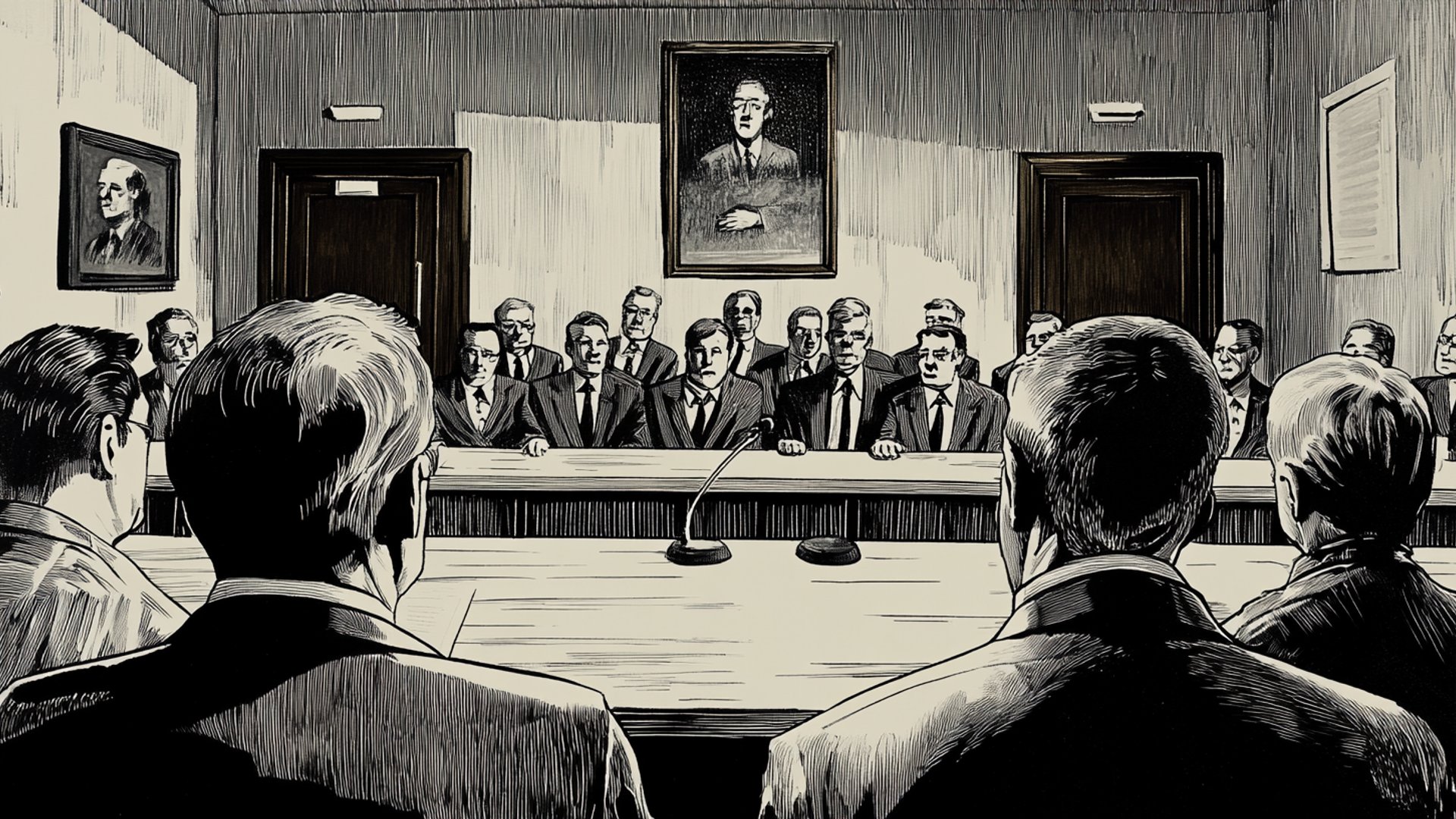
here is a registry in America that is not printed on paper. It is written in corridors, in the backs of lecture halls, in the quiet pact between a dean and a donor, in the lists of names that float from one appointment to the next like lanterns across a dark canal. The registry has no single keeper and yet it is kept: a ledger of narrow doors—what we call elite universities—and the lives that pass through them. To deny the existence of the registry is to confuse silence with neutrality. To read it honestly is to see how much of our public life has been shaped by a few institutions that function not merely as schools, but as distribution centers of power.
What follows is not crusade but cartography: a map of how American pedigree is formed, multiplied, and normalized; how a child's odds of entry are correlated with parental income; how the same institutions supply, with uncanny regularity, many of the country's most powerful decision-makers; and what is lost when the state, the economy, and the cultural commons recruit from a narrow guild of diplomas. Where possible, the map is etched with evidence rather than sentiment.
⸻
I. The Gate and the Key
Consider a simple pair of facts. Fewer than one in two hundred Americans attends an "Ivy-Plus" college—the eight Ivies plus Stanford, MIT, Chicago, and Duke. Yet those dozen schools account for more than a tenth of Fortune 500 CEOs, a quarter of U.S. senators, and three-quarters of Supreme Court justices appointed in the last half-century. That is not gossip; it is the opening paragraph of a large administrative study linking tax data, test scores, applications, and post-college careers. The same study isolates the mechanism by which children from the top one percent of the income distribution gain an admissions advantage at these colleges: legacy preferences, weight on non-academic ratings cultivated in elite high schools, and athletic recruitment in sports that skew affluent. Conditional on similar test scores, applicants from the top one percent are about 58% more likely to be admitted than middle-class peers; at flagship public universities, by contrast, such an income-based admissions premium is absent.
The point is not that these colleges teach the secret handshake. The point is that they control the antechambers. When admission itself becomes a credential stamped with the country's highest imprimatur, the door is not only an entrance to instruction; it is a singular conduit to internships, elite graduate programs, clerkships, and the firmament of prestigious firms. The same Ivy-Plus work finds that attending one of these colleges, instead of a flagship public, causally raises the chance of reaching the top one percent of earnings, nearly doubles the probability of attending an elite graduate school, and almost triples the odds of landing at a "prestigious firm." The treatment effect is largest at the top of the outcome distribution—the skylights of American life.
This is the registry at work. Some will object that the country needs guardians proven by trial. Fair enough; the best operating room should not be staffed by lottery. But it is an odd trial that admires standardized metrics in public rhetoric and then quietly elevates other traits—legacy, "leadership" as interpreted by expensive schools, recruitment pipelines—when the stakes are highest. The cost of that contradiction is not merely unfairness at the margin; it is a permanent sclerosis in who gets to try.
⸻
II. The Admissions Machine as a Social Technology
Much of the modern debate is chaffed by moral language—"merit" and "fairness" and the grieved dignity of "deserving." Economists prefer to weigh mechanisms. The Ivy-Plus evidence tells us the admissions advantage for top-income applicants is mostly institutional: an assemblage of preferences that advantage children of alumni (legacies), emphasize non-academic ratings cultivated in costly settings, and recruit athletes in sports tied to wealth. Remove those three features and refill with students who have the same test score distribution as the current class, and the bottom 95%'s share at these schools rises by nearly nine percentage points. Since leadership pathways are demonstrably shaped by attendance, this is not merely campus reform; it is downstream civic reform.
Policy has begun to stir. Colorado banned legacy preferences in 2021. Virginia followed in 2024 for its public institutions, with unanimous legislative support and a gubernatorial signature; similar efforts have advanced (and in some states passed) since. Civil rights authorities have opened investigations into whether legacy and donor preferences at Harvard violate Title VI, the federal law banning discrimination by recipients of federal funds. California has enacted a 2024 ban that will apply to private non-profits starting in 2025, and other states are considering similar measures. These changes are not a revolution; they are the slow untying of a single knot.
A caution is useful: the best evidence shows that at public flagships, admissions rates are flat with respect to parental income once test scores are held constant; the problem there is differential application and matriculation, not preferential admission. Policy levers for publics should therefore emphasize outreach, fee waivers, and targeted counseling for students who are academically competitive but under-apply. As always, mechanisms differ by sector.
⸻
III. The Judiciary's Narrow Stair
Nowhere is pedigree's multiplication more visible than in federal law. The current Supreme Court is famously monocular in legal training: every sitting justice holds a J.D. from Harvard, Yale, or (in one case) Notre Dame. The Court's official biographies make that plain.
The pipeline beneath is even more concentrated. Federal clerkships—one- or two-year posts with judges that open doors to elite practice, academia, and, for a select few, the Supreme Court—are cornerstones of legal credentialing. In 2024, the University of Chicago placed the highest share of graduates into federal clerkships, followed by Yale, Harvard, Stanford, and Notre Dame; nationwide, only about 3.3% of law graduates secured such roles, with a third of all federal clerks coming from a handful of schools. The Supreme Court clerkship market is narrower still and dominated by a small cluster of law schools and "feeder judges." That is not an indictment of quality—these are excellent institutions—but it is a structural throttle on who accumulates the credentials that translate into judgeships, top advocacy posts, and elite law-teaching careers.
If law is the country's operating system, clerkship pipelines are the privileged APIs. Entry to them is not random; it is college-and-law-school dependent, and those dependencies are sustained by reputation loops that resist perturbation. To change any of this requires not slogans but alternative ladders.
⸻
IV. The Company Town of Prestige
What about the private economy? Here nuance is essential. The mythology suggests that major corporations are ruled by Ivy graduates as a class. Reality is mixed. Analyses of Fortune 100 and Fortune 500 chief executives show a minority hold Ivy undergraduate degrees—on the order of 10–12%—and an even smaller fraction hold Ivy MBAs. Many top CEOs are products of public flagships or regional universities. On raw counts, the C-suite is less Ivy-dominated than the judiciary.
But two clarifications matter. First, CEO counts obscure pipelines deeper in finance, consulting, and corporate law—the places where board members, general counsels, and deal-makers are recruited. Elite graduate programs, prestige firms, and certain investment banks are disproportionately seeded by Ivy-Plus and their close peers. Second, the raw share still represents heavy over-representation relative to base rates: when only a few tenths of a percent of Americans attend Ivy-Plus but double-digit shares of Fortune 100 CEOs do, the multiplier is stark—even if the majority of CEOs are non-Ivy. The Chetty-Deming-Friedman study provides the structural picture: attendance causally boosts entry into "prestigious firms," the stepping stones to senior leadership whether or not the ultimate top job is Ivy-stamped.
Culture tracks a similar logic, though with patchier data. Rhodes Scholars and a long roll of leading journalists, museum directors, and media executives come disproportionately from the same narrow set of schools; the Ivy-Plus paper's Figure 1 includes Rhodes-level outcomes among the markers of elite formation. None of this is conspiratorial. It is the mathematical consequence of recruitment practices that search where prior searches succeeded, of internships accessible to those living near unpaid opportunities, of alumni networks that function like guilds.
⸻
V. Theories for a Quiet Aristocracy
The registry of narrow doors can be read through three lenses—signaling, assortative matching, and opportunity hoarding—that together explain how a selective system becomes self-stabilizing.
Signaling. In Michael Spence's classic model, education communicates information about ability to employers even apart from the human capital it adds. A Harvard or Yale degree signals persistence, prior competition, and access to scarce resources; employers, aware of the signal's value in an environment of uncertainty, pay a premium to reduce hiring risk. Once that premium exists, students rationally seek the signal, and institutions rationally cultivate scarcity to preserve it. The cycle loops.
Assortative matching. Couples and firms alike sort by observed and inferred traits. In a labor market where elite firms prefer elite credentials, and where high-income families mate and network within the same institutional archipelago, the winners of one generation become the admissions advantages of the next. The macro picture, summarized in Alan Krueger's "Great Gatsby curve," links high inequality with low intergenerational mobility; parental resources buy school quality and preparatory advantages, and those advantages purchase the next generation's places. The outcome is not scandal in the criminal sense; it is equilibrium.
Opportunity hoarding. Charles Tilly described how powerful groups create and maintain boundaries around profitable niches, reproducing advantage not only by direct exclusion but by networked preference: recommending the familiar, slotting protégés into internships, setting norms that are, on paper, neutral but in practice costly for outsiders. In higher education, the mechanisms are legacy preferences, early decision, fee-bearing extracurriculars, and the conversion of non-academic ratings into decisive leverage. In the professions, they are clerkship pipelines, partner-track sponsorships, and boards that recruit from friends of friends.
Each lens captures part of the pattern. Together, they explain a country wherein the diction of meritocracy overlays the geology of caste.
⸻
VI. The Missed Nation
"Lost Einsteins" is an unfortunate phrase; the missing minds are not all inventors and the inventions are not all patents. But the research behind the phrase is painstaking. When otherwise similar children grow up near inventors or in communities where innovation is visible and mentored, they are vastly more likely to become inventors themselves. Children from the top one percent are ten times more likely to become inventors than those below median income; racial and gender gaps are similarly large. Exposure, not just aptitude, powers the pipeline. The authors' conclusion is a quiet indictment: the country has systematically left genius on the table by tying opportunity to parental income and neighborhood.
Higher education repeats the pattern. The "Mobility Report Cards" project—linking tax records to college attendance for tens of millions of students—shows that top-income families are seventy-seven times more likely to send a child to an Ivy than bottom-quintile families. Some public institutions (think CUNY, SUNY-Stony Brook, Cal State campuses) are astounding engines of mobility; many elite privates are engines of preservation. We claim to select the "best," but the pool is heavily pre-filtered by the cost of getting into the audition.
The economic costs are not abstract. Diverse teams tend to make better decisions and, in multiple studies, outperform on revenue, innovation, and profitability—especially when diversity extends beyond tokenism to real variance in experience and problem-solving heuristics. When leadership is drawn from a thin stratum of schools and social classes—when everyone has read the same cases, summered at the same firms, and learned to fear the same reputational punishments—the ideas that survive are merely the ideas that fit. The economy loses optionality. The state loses imagination. The culture loses surprise.
Now invert the picture. If elite colleges eliminated legacy preferences and reweighted non-academic ratings that track private-school polish rather than public value, the socioeconomic composition of their classes would shift, and so—by causal chain—would the composition of top earners, elite graduate cohorts, and prestigious firms. The same modeling implies, strikingly, that even modest admissions reforms could have produced a nontrivial number of additional Supreme Court justices, senators, Nobel laureates, and Treasury secretaries from the bottom sixty percent of the income distribution over the last fifty years—had those reforms been adopted system-wide. This is not romanticism; it is arithmetic.
⸻
VII. The Post-Affirmative Action Paradox
The Supreme Court's 2023 decision against race-conscious admissions at Harvard and UNC did not end the debate; it moved it. In the absence of race as an explicit factor, the weight of other non-academic criteria grows larger—and thus the relative value of legacy preferences and donor ties becomes more controversial. Federal civil-rights authorities have begun to ask whether those preferences have a discriminatory effect, while states have targeted legacy admissions by statute. The paradox is exquisite: in the name of formal equality, we have placed heavier stress on the informal gates that transmit advantage. The country will either learn to attack those gates or watch the registry harden.
⸻
VIII. Remedies That Cut to the Wood
A serious program should begin with frictional reforms, proceed to pipeline diversification, and end with changes to how we use credentials once issued.
-
End legacy and donor preferences at private as well as public institutions. The legal route is messy; the policy route is clearer. Whether by statute (as in Colorado, Virginia, Maryland, California, Illinois) or by voluntary policy, the practice should cease. Colleges exist to educate and sort by talent and potential, not to notarize inherited networks.
Reweight non-academic ratings toward public value. Many "leadership" signals track expensive activities. Admissions can emphasize sustained work, care obligations, community translation, and contributions that require sacrifice rather than sponsorship. (The evidence shows those non-academic ratings, as currently constructed, have little to no predictive power for the elite outcomes that justify their weight.)
-
Kill the early-decision tax on liquidity. Binding early programs reward those who can commit without comparing aid packages. Ending or loosening ED would reduce an equity penalty disguised as scheduling.
Widen the internship funnel. Government, media, museums, and think tanks should make paid internships the rule and structurally recruit from regional universities and community-college honors programs. Prestige employers should publish campus-neutral application portals to dilute the alumni-only default.
Randomize at the margin. At scale, many applicants are indistinguishable on academic metrics. Where a selection committee confronts a band of genuinely equal candidates, a lottery is more defensible than a taste for polish that tracks wealth. Randomization does not correct inequity upstream, but it breaks the habit of mistaking confidence for merit.
-
Make clerkship and fellowship ladders broader. Courts can reserve a share of interviews for applicants from public law schools with top class ranks; federal agencies can sponsor "open track" fellowships for graduates of mobility-engine colleges; elite firms can create "second-look" hiring rounds that recruit outside the on-campus circuit.
Change how boards recruit. Require public companies to disclose the search process for independent directors and the educational backgrounds of candidate pools, not just final appointees. Sunlight disrupts rituals.
These measures are not denunciations of excellence. They are a defense of it—against a form of credential inflation that confuses the ability to navigate a maze with the wisdom to design a city.
⸻
IX. The Human Texture
Policy can be dry; lives are not. Imagine the valedictorian of a rural high school who looks after two siblings and works nights at a grocery store. She does not have a rowing coach, a violin purchased in Vienna, or a robotics team that travels to nationals; she has a GED parent, a reliable car with a failing alternator, and a guidance counselor who serves four hundred students. Her SAT score is excellent but not shimmering. Her essays are honest but not choreographed. She applies to a flagship state university and wins full aid; she does not apply to an Ivy-Plus because the application fee would pay a week of groceries and because "people like us don't go there." Economists call this "undermatching," a sterile word for a bright life steered into a narrower strait by cost, counseling, and custom. Multiply her by tens of thousands. Then imagine the country that could have been.
The registry does not require malice. All it needs is the repetition of good intentions that never meet a better rule. A hiring committee remembers that the last fellow from X did well, so they look again to X; a judge wants a clerk who "can hit the ground running," which is to say someone who has already been taught to speak the dialect of chambers; a board believes in "fit," which is to say the absence of friction. The machinery of habit is almost tender in its persistence. It does not hate the outsider. It simply cannot hear them.
⸻
X. The Country of Wider Doors
There is a myth that America has only two choices: the clerisy of elite credentials or the chaos of anti-intellectualism. This is staging, not truth. A republic serious about talent would flood the zone with opportunity: universal high-quality early education; funded summer academies in every county; national service that confers tuition credits; investments in public universities as engines of research and mobility; and an admissions architecture that prizes difficulty overcome as much as polish acquired. It would treat a CUNY or a Cal State honors graduate as a live wire for clerkships, fellowships, and labs. It would regard the first-gen student who held a household together as a leadership case study no less than the student body president whom a private school has burnished for a decade.
There is also a myth that the registry is unbreakable. But registries are human artifacts. The last decade has already seen rules change: courts recognizing the over-concentration of clerkship pipelines and making (slow) efforts to widen them; states banning legacy preferences; civil-rights agencies interrogating donor admissions. The most serious empirical work has furnished a fact-based critique that rises above culture-war din. We are not groping in the dark. We can see the hinges.
⸻
XI. A Short Walk Through the Counterarguments
"But these schools are the best." They are excellent. The question is not whether they should exist, but whether they should be permitted to convert non-academic advantages into decisive admissions margins when those advantages do not predict the elite outcomes that justify the schools' special place. The best evidence shows that removing legacy, certain non-academic boosts, and skewed athletic recruitment would diversify the class without lowering academic standards.
"The market already rewards ability." Markets reward signals under uncertainty. That is why employers lean on brand names. But brand reliance has opportunity costs; it narrows search and induces herding. If we want markets to allocate talent well, we must reduce the cost of finding it beyond a half-dozen quads. Spence taught us that signals are efficient when they correlate with productivity and cheap for the high-ability to acquire; they are inefficient when they can be purchased by wealth or inherited by surname.
"The private economy proves pedigree doesn't rule." True that CEO rosters are not Ivy monopolies; it is also true that relative to their tiny base, Ivy-Plus grads are vastly over-represented at the very apex and, more importantly, in the pipelines that determine who is eligible for apex roles. Both facts can be true, and they are.
"Don't we risk politicizing admissions?" Admissions have always been political: legacy, donor interest lists, and sport recruitment are politics in miniature. The question is whether we will continue to tolerate implicit politics that privilege wealth while pretending to scorn explicit policies aimed at widening access.
⸻
XII. A Small Theology of the Threshold
Every society inherits two kinds of doors: those that keep danger out and those that keep incumbents in. The registry of narrow doors has served, for a century, as a way to rapidly assemble competence, link it across professions, and give a sprawling country a sense that excellence has a home. It has also functioned as a kind of secular priesthood: a rite, a robe, a set of permissions. We can keep the competence and retire the priesthood.
The poem of a republic is that a child can choose a different future than the one purchased for them by their parents. We will not re-write that poem by renouncing excellence; we will re-write it by placing excellence within reach, and by recognizing it when it appears off-syllabus—at the back shift of a hospital cafeteria, in the soldering of a broken motherboard, on the bus ride between school and work when the essay gets done on a phone screen. We will re-write it by admitting that the registry, for all its past service, has become a narrow theology of potential.
The day the registry loosens, nothing dramatic will happen. There will be no thunderclap, no edict. A judge will hire a clerk from Stony Brook; a museum will post a paid internship that reaches a commuter campus; a Senate committee will discover that the most prepared witness did not summer at a K Street firm; a dean will announce that the words "legacy" and "development" are no longer currencies in her shop. Then the next year it will happen again.
That is how cities change their maps. Quietly, and then forever.
⸻
Sources & Further Reading
Chetty, Deming, Friedman. Diversifying Society's Leaders? The Determinants and Causal Effects of Admission to Highly Selective Private Colleges (NBER Working Paper 31492; Opportunity Insights paper & PDF). Key findings on admissions advantages (legacy, non-academic ratings, athletic recruitment) and causal effects on elite outcomes; leadership over-representation from Ivy-Plus; simulated impacts of reform.
-
U.S. Supreme Court Biographies. Official education backgrounds for current justices (Harvard, Yale, Notre Dame).
Reuters / ABA Data (2024). Federal clerkship pipelines by law school; top placements from Chicago, Yale, Harvard, Stanford, Notre Dame; overall scarcity of federal clerkships.
-
Harvard ALDC Analyses (Arcidiacono et al.). Legacy/athlete/dean's list/children of faculty ("ALDC") admission rates at Harvard >30% vs ~5.5% for non-ALDC; peer-reviewed and working paper versions.
-
State Legacy Bans / Investigations. Colorado (first), Virginia (2024) ban for publics; California (2024) ban covering private non-profits effective 2025; federal Title VI investigation into Harvard legacy/donor preferences.
-
"Mobility Report Cards" (Chetty et al., 2017). Top 1% students 77× more likely to attend Ivy than bottom-quintile peers; mobility engines at public institutions.
"Lost Einsteins" (Bell, Chetty, Jaravel, Petkova, Van Reenen, 2017–2018). Exposure to innovation drives invention; massive gaps by income, race, gender.
Great Gatsby Curve (Krueger and follow-on). Link between inequality and intergenerational mobility—background theory for how income stratification compounds.
Diversity & Performance. Cedric Herring (2009) on racial/gender diversity and firm outcomes; replication literature; broad evidence base for decision quality and innovation.
CEO Alma Maters. Fortune and other analyses showing minority Ivy representation among Fortune 100/500 CEOs (roughly 10–12% undergrad; <10% Ivy MBA), illustrating over-representation relative to base rates yet far from monopoly.
⸻
Acknowledgment of limits: Leadership is not a sin, and excellence is not a crime. But a republic that confuses exclusivity with excellence will get less of both. The registry endures only as long as we agree to read from it. The ledger can be amended. The doors can be widened. The country can decide that pedigree is a path, not a passport.