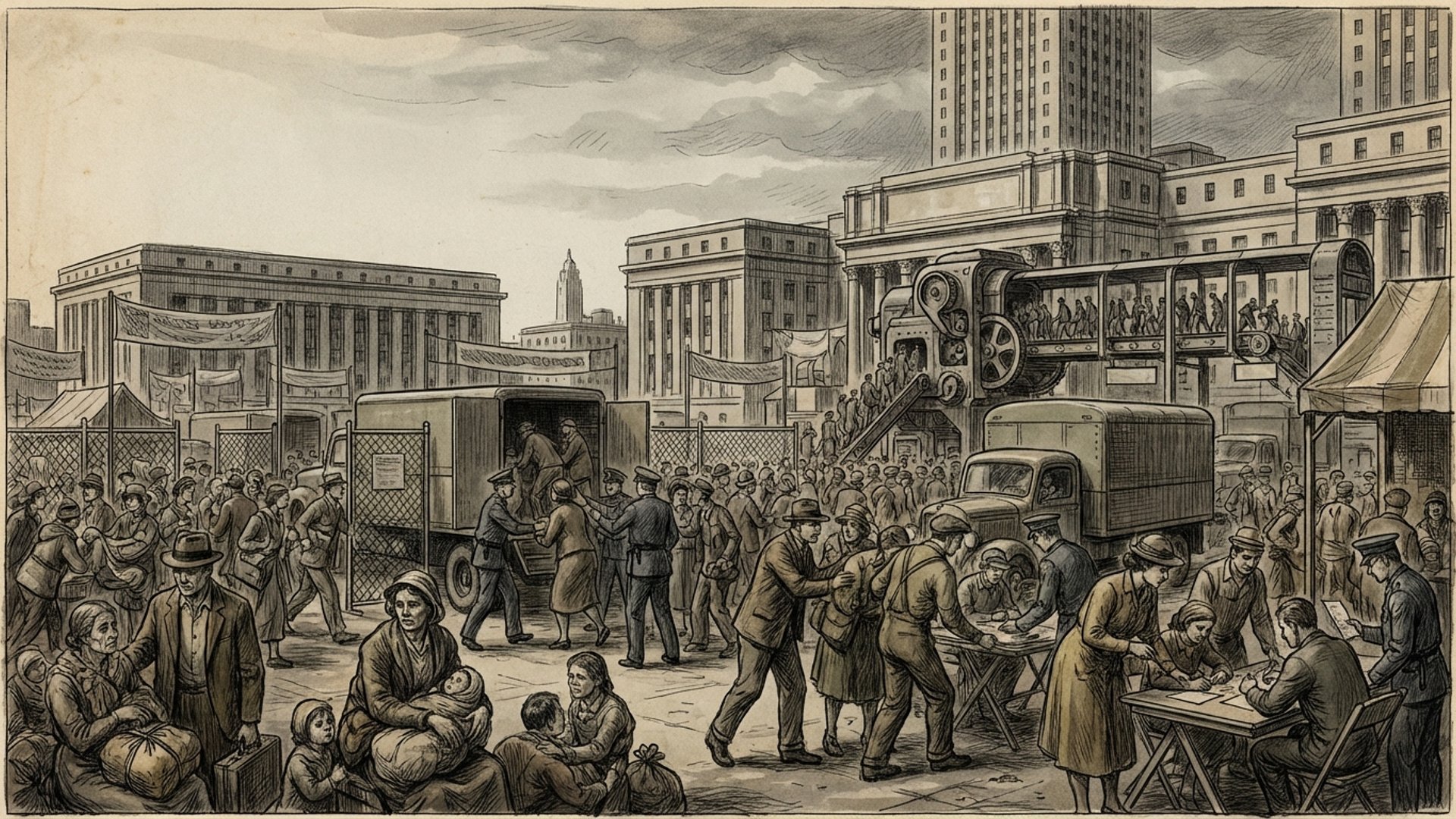
Policy as machine: A comprehensive analysis of immigration enforcement, border flows, and human consequences under Trump's second-term reset
Prologue: A ledger, not a sermon
Policy is a machine: rules become incentives; incentives become flows; flows become human fates. From late 2015 to November 2025 the machine has been re-geared several times. The border wavered between "metering," Title 42, CBP One, and—this year—shutdowns and injunctions. Interior enforcement has swung from priority-driven to maximalist. Courts—both Article III and the immigration courts under DOJ—have periodically stepped in, sometimes accelerating, sometimes braking. This essay reconstructs the machine as it exists after ten months of the second Trump administration, then looks backward across the decade to judge what has changed—on human rights at the border, the scale and order of removals, detention, labor markets and prices, and the quieter variables that tilt the system: data transparency, legal channels, and the inescapable arithmetic of demography.
I. The 2025 Reset: Orders, statutes, and a court shock
Executive orders and policy revocations. On January 20, 2025, the White House issued an order to "secure the borders," outlining barriers, personnel surges, and stepped-up enforcement across DHS and DOJ. That same day, a separate order suspended the U.S. Refugee Admissions Program (USRAP), effective January 27, pending new vetting "findings." These moves accompanied the termination of the CBP One appointment pathway at ports of entry and the CHNV parole processes (for Cubans, Haitians, Nicaraguans, Venezuelans), confirmed in CBP's own January update. Independent explainers and legal analyses concur on the immediate cancellation of roughly 30,000 pending appointments and the shutdown of the parole channels.
Statute: the Laken Riley Act. Nine days later, January 29, President Trump signed the Laken Riley Act—his first enacted bill of the term—expanding mandatory detention and enabling state attorneys general to sue the federal government for alleged under-enforcement. The measure is now lodged in the U.S. Code; both House and Senate dockets track its movement this session.
Courts: the asylum injunction. On July 2, a federal district judge (Randolph Moss) blocked the administration's attempt to suspend asylum access at the southern border—ruling it exceeded statutory authority. The order was stayed two weeks to allow appeal. The practical effect was to limit the most sweeping application of the day-one proclamation while other elements of the 2025 enforcement posture remained. (In short: the legal right to apply for asylum persists, even as the administration restricts channels to reach the booth.)
A late-year shock to skilled immigration. In September, the White House issued a proclamation imposing a supplemental $100,000 payment requirement on new H-1B petitions for a one-year period, while DHS simultaneously proposed a separate weighted lottery that favors higher wages—both now moving through guidance and litigation. White House, USCIS, and State Department notices confirm scope and timing; major outlets and trade groups report immediate legal challenges and clarifications (notably that it's not retroactive to existing H-1B holders). (Separately, the pre-existing registration fee increase to $215 for FY2026 was finalized earlier by USCIS.)
II. Border flows: the arithmetic of shut gates
Encounters have collapsed in late 2025. DHS and CBP report the lowest October on record—30,561 encounters nationwide—as FY2026 begins. ABC's read-out echoes the drop and frames it against prior periods. DHS says FY2025 ended with 237,565 southwest Border Patrol apprehensions—a 55-year low—after the policy reset and international cooperation tightened flows.
Interpretation: A policy that closes legal entry channels (CBP One/CHNV) and raises deterrence can reduce measured crossings quickly, but it reallocates people: into Mexico, Panama, and detention backlogs rather than asylum reception. HRW documents February–May 2025 expulsions to third countries (e.g., Panama) and heavy constraints on border processing. The July injunction halting the broad asylum suspension matters—but arrivals were already historically low by autumn.
III. Detention and removals: scale, conditions, and oversight
Detention population hit an all-time high. Multiple datasets place ICE detainees above 61,000 in August 2025—specifically 61,226 on August 23—apparently the highest single-day levels in the modern series. By November, detention reached 66,000. Independent trackers (Vera), nonpartisan researchers (Migration Policy Institute), and case-level sources (TRAC) converge on that order of magnitude.
Oversight gaps widened just as detention surged. During the October funding lapse, ICE's Office of Detention Oversight was furloughed; congressional and media scrutiny followed. A Senate probe this fall detailed medical neglect across facilities—insulin interruptions, delays, and basic sanitation failures—reviving long-standing quality-of-care concerns.
Removals claimed at scale. DHS touts "over 2 million illegal aliens out of the United States in less than 250 days," a composite metric that mixes formal removals, returns, and other outcomes. Treat it as an administration claim pending independent reconciliation; official monthly "lifecycle" tables are currently marked as delayed/under review on the DHS statistics site, limiting external verification.
Country-specific returns: Venezuela. After a March agreement, removal flights to Caracas resumed; officials told CBS nearly 8,000 Venezuelans had been deported by late October. Earlier, some Venezuelans were transferred to El Salvador amid controversy; by mid-year, arrangements shifted toward direct repatriations to Venezuela. (Use Reuters/AP coverage for the diplomatic arc.)
Facility expansion. Reporting shows plans to reopen troubled prisons for immigration detention—a cost/conditions choice with predictable human-rights risks.
IV. Human rights at the border: access, law, legitimacy
Asylum access remains law; practice is contested. The July injunction underscores that the right to apply for asylum cannot be nullified by proclamation. But practical access depends on administrative channels. Ending CBP One as a scheduling gateway—and cancelling pending appointments—removed the de facto line for many who sought inspection at ports of entry. Rights organizations document February–May expulsions to third countries and reports of mistreatment, with limited recourse while oversight offices are shuttered.
Detention conditions and due process. The combination of record headcounts, furloughed oversight, and revived large-scale facilities produces classic "failure mode" risks: delayed medical care, restricted counsel access, and transportation bottlenecks. The Senate report details conditions; WaPo and others chart the oversight vacuum.
Refugees and protection pathways. With USRAP suspended since late January, third-country resettlement fell to exceptional carve-outs while the administration reviews and re-designs vetting. Litigation trackers and legal advisories confirm the suspension's scope.
V. The courts: bottleneck, then acceleration
Completions are up; backlog down (from a very high base). DOJ's EOIR reports 722,000+ case completions through eleven months of FY2025—a record—with a reported backlog reduction exceeding 400,000 cases since January, and end-of-summer backlog near 3.43 million per TRAC. Hiring, temporary judge designations, and management directives contributed. Independent coverage notes the first decline in the backlog in over a decade.
But quality signals are mixed. Analysts track rising in-absentia orders and lower asylum grant totals in 2025 compared to 2024, reflecting faster throughput with more denials—while GAO previously flagged EOIR's shaky attendance data regime. The basic trade-off is familiar: speed versus depth. A management-metrics push can reduce inventory while increasing Type-I/II errors; the real question—unanswered for now—is whether 2025 denials survive appellate review in 2026–2027.
VI. Labor markets and the macroeconomy: supply, prices, and the new scarcity
Immigration's 2021–2024 surge cooled an overheated labor market; 2025 reversals tighten supply. Fed researchers and private forecasters attribute part of 2023–2024's rebalancing—slower wage growth, strong payrolls without runaway inflation—to higher immigrant labor supply. CBO's July 2024 scoring found the surge raised potential output; the September 2025 update revises net immigration downward for 2025–2033 due to administrative changes, implying weaker labor-force growth ahead. Regional Fed work shows declining immigration shaving GDP growth with only modest near-term effects on inflation, but the macro thrust is clear: fewer workers, lower breakeven job growth, and tighter constraints on certain sectors.
By autumn 2025, some Fed officials explicitly tie macro strength (and risks) to immigration flows. Public remarks from policymakers (Kugler, Barkin) and sell-side research frame immigration as a supply-side swing factor: when flows fall—via border policy and skilled-visa restrictions—labor tightness can re-emerge unevenly.
Skilled pipelines are now a policy experiment. USCIS has already raised registration fees for H-1B to $215 for FY2026, and the September proclamation adds the $100,000 payment for new H-1Bs for a year, while DHS proposes a wage-weighted selection regime. The combined effect will likely reduce volumes and raise average wages among those selected—precisely the design goal—but shift talent toward Canada/EU and into domestic "work-around" categories (L-1s, O-1s, F-1 OPT where possible).
VII. Numbers of people expelled: scale and methods
Administration counts are high; independent reconciliation lags. DHS's September milestone claim (">2 million out in <250 days") reflects accelerated returns/removals plus "voluntary departures," expedited processing, and port-of-entry turn-backs. Without current, disaggregated OHSS tables—marked delayed—analysts must triangulate via CBP monthly updates, EOIR completions, and ICE detention intake/outflow.
Modalities matter. The 2025 playbook emphasizes: (1) air removals to countries now accepting repatriations again (notably Venezuela), (2) third-country transfers (documented by HRW for Panama in February), (3) expedited removals and detention expansion, with oversight gaps noted above. This is a throughput system designed for speed and distance, not for channeling people into asylum adjudication.
VIII. Rights and human conditions for those removed or detained
Conditions inside detention: Senate investigators described dozens of medical neglect cases—diabetes care lapses, sanitation failures—underscoring the mismatch between record headcounts and reduced oversight.
For those expelled: HRW reports on group expulsions to Panama and difficulties accessing asylum at U.S. ports after the end of CBP One, raising non-refoulement concerns. Transfers and rapid removals heighten the risk that protection claims are truncated. (The July injunction on asylum helps at the margin but does not restore the earlier appointment pipeline.)
Oversight capacity: Beyond the furlough of ODO during the shutdown, reporting in March documented elimination or severe curtailment of DHS internal civil-rights/ombudsman offices—removing avenues for complaints and systemic fixes.
IX. Other structural factors (the "quiet levers")
Data transparency. The DHS Immigration Enforcement Monthly Tables—the best end-to-end view of outcomes—are explicitly "delayed while under review." That limits outside auditing of the administration's claims and frustrates policy evaluation.
Immigration courts' capacity choices. DOJ has layered temporary judges and management directives to accelerate completions even as earlier in-house reforms (Biden-era) are reversed (e.g., dismissals for prosecutorial discretion scaled back). The official releases show speed; GAO and independent trackers urge caution on metrics and due-process tradeoffs.
Legal channels. With USRAP paused and CBP One/CHNV ended, humanitarian pipelines have narrowed. Meanwhile, H-1B costs jumped and selection rules may tilt toward higher wages. The net is fewer lawful pathways at both ends (protection and skills), with predictable spillovers into irregular channels (curbed at the border this year) or into other countries' systems.
X. Ten-year evaluation (2016–2025): What changed?
From "metering/Title 42" to "appointments" to "closure + injunction." The decade oscillated. The lesson is institutional: courts will enforce the statutory right to apply for asylum, but the means to reach a lawful booth can be administratively throttled or opened—and that is where human rights are lost or honored.
Detention as governance. The U.S. system repeatedly substitutes detention capacity for case capacity. 2025 sets a new ceiling: 66k+ detained, weaker oversight, and more facilities. Long-standing quality-of-care and due-process critiques reappear mechanically at higher scale.
Macro: immigration as a supply valve. The 2021–2024 immigration rebound helped cool wages and support growth; 2025's contraction will shave labor-force growth and potential output, even if near-term inflation impacts are modest. This is arithmetic more than ideology.
Transparency and legitimacy. When the best monthly enforcement tables go dark, trust erodes. Policymakers must restore high-frequency, disaggregated reporting; otherwise, narrative fills the vacuum and litigation becomes the only auditor.
Legal immigration as competitiveness policy. The $100,000 H-1B payment (one-year) and proposed wage-weighted lottery reframe high-skill immigration as a scarcity good. It will select for higher wages, yes, but also export marginal innovations to peers with cleaner, cheaper routes. The country that treats talent pipelines like infrastructure usually wins.
XI. Recommendations (systems, not slogans)
Restore lawful channels alongside enforcement. If the injunction on asylum stands, re-establish a transparent, auditable appointment system at ports of entry (it needn't be CBP One as-was), with randomized selection and anti-fraud controls, to avoid re-creating the irregular funnel the closures were meant to eliminate.
Cap detention; invest in adjudication. Hard-cap average daily population; channel savings to EOIR capacity (judges, interpreters, digital service), while rebuilding independent oversight. Speed without counsel and medical care is not "order"; it is entropy with uniforms.
Publish the delayed enforcement tables. Make the OHSS lifecycle series current, with machine-readable cohorts linking encounters, releases, court outcomes, and removals. Policy debates then proceed on shared ground.
Rebalance skilled immigration. The wage-weighted proposal may have merit if paired with lower frictions (not higher) and with protections for small firms and research institutions. If the $100,000 requirement survives court review, it must be narrow, time-limited, and accompanied by exemptions that protect hospitals, startups, and frontier science.
Coda: The moral geometry
A state is a map of permissions. In 2025 the map narrowed at its legal crossings and lengthened its shadow beyond the river—toward third-country deals and cavernous detention. The courts redrew a line; the agencies redrew another. Meanwhile, the labor market whispers an unromantic truth: people are part of productive capacity. The decade's lesson is neither open nor closed; it is configured. Build channels that are legible and lawful. Keep ledgers public. Staff the adjudication first. A republic can be both orderly and generous—but only if it treats migration like the infrastructure it is.
Notes on sources (selected, high-leverage)
- CBP/DHS on record-low October (30,561) and FY2025 apprehensions (237,565), and January policy changes
- White House/EOs: "Securing Our Borders," USRAP suspension, and H-1B proclamation (Sept 19, 2025)
- Laken Riley Act: DHS announcement and coverage (signed Jan 29, 2025)
- Asylum injunction: Judge Randolph Moss ruling July 2, 2025 (AP/Reuters/WaPo)
- Detention: Vera/MPI/TRAC—61,226 on Aug 23, 66,000 by Nov; oversight furlough reporting
- Venezuelan returns: Reuters/AP and CBS (nearly 8,000 by late Oct)
- HRW reports on February–May expulsions and access constraints
- EOIR completions/backlog—722,000+ completions FY2025, backlog near 3.43M
- CBO/Fed research on immigration and macroeconomy (July 2024, Sept 2025 updates)
- H-1B registration fee ($215 FY2026) and $100,000 proclamation; litigation and clarifications
This article is part of the Sol Meridian Governance series, examining how institutions shape democratic capacity.