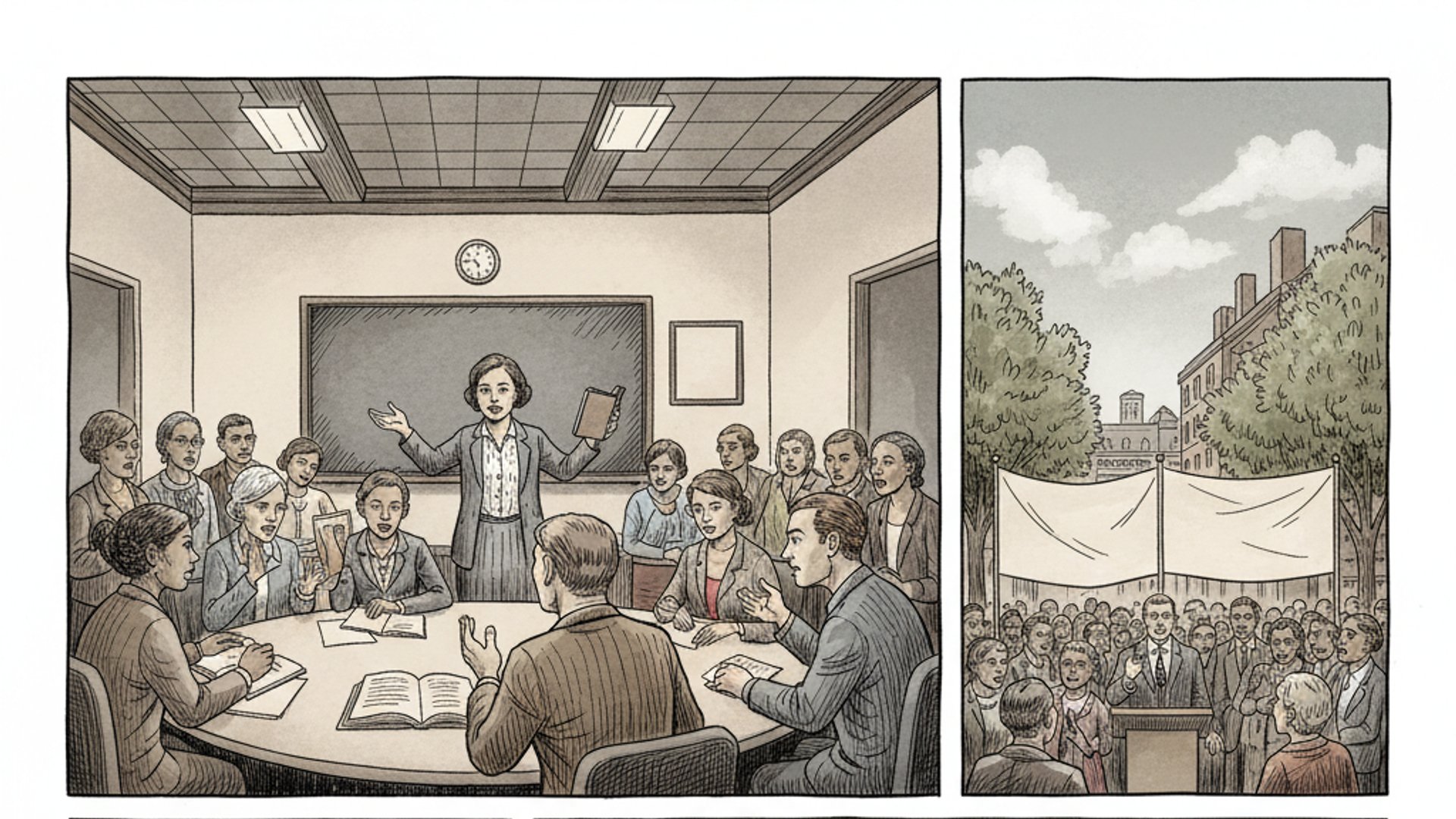
isagreement is not a failure of learning but its engine. Where statutes and slogans chase neutrality by subtraction, classrooms can teach reliability by craft. This essay offers a complete protocol for teaching contested material without quotas or theater—steps that make argument safe, evidence visible, and change measurable. We do not seek serenity; we train competence under heat.
First Principles
Teach disagreement as a skill. Like writing or coding, it improves with structure and feedback.
Build safety through procedure, not silence. Rules, turns, and timing protect people better than censorship.
Let evidence carry weight. Not all claims weigh the same. Methods assign gravity.
Separate discomfort from harm. Students can feel tension without suffering damage.
Aim for change. Every strong class shifts understanding, even slightly.
Post these rules. Refer to them aloud. Repetition makes courage routine.
Set the Stage
Layout. Arrange desks in a hollow square or circle so every voice has a face.
Materials. Pair one authoritative text with one counter-text chosen for critique, not parity.
Roles. Rotate Facilitator, Evidence Clerk, Timekeeper, and Listener-at-Large. Responsibility breeds calm.
Contract. Sign a one-page agreement on conduct. Students own the process.
Twelve Moves for Structured Disagreement
1. Frame
State the question, stakes, and method. Show the roadmap.
2. Provide Context
Offer a brief capsule—dates, terms, law, or method—to lower heat by widening frame.
3. Text Before Talk
Read silently. Meet the material itself, not rumors of it.
4. Clarify
Only questions of meaning or fact. No claims yet.
5. Claim Tickets
Each student writes one claim they believe true and why it matters.
6. Steel-man
In pairs, students strengthen an opponent's claim before critiquing it.
7. Build an Evidence Ladder
Rank supports from anecdote to consensus. Force claims to climb.
8. Challenge Rounds
Hold two quick rounds: one on truth, one on relevance. Limit turns to a minute.
9. Error Audit
Identify reasoning errors: straw man, false equivalence, base-rate neglect. Admit one personal slip.
10. Synthesis Attempt
A student drafts the best current answer with uncertainties marked.
11. Exit Reflection
Each writes what changed—fact, frame, or feeling.
12. Archive
Upload photos of ladders, logs, and syntheses. Disagreement leaves a record.
Scripts for Tough Moments
When tempers rise: "Pause. Name the claim, not the person. Evidence next."
When someone feels attacked: "We protect people, not ideas. Point to the sentence; we'll separate you from it."
When talk drifts: "Condense to one line. Time is shared."
When false balance appears: "We don't equalize; we evaluate. What lifts this claim up the ladder?"
Teachers speak calmly, quickly, and stay factual. Tone teaches.
Choose Texts Wisely
Anchor each unit in the discipline's best evidence.
Add one counter-text as a case study in reasoning, not legitimacy.
Include a brief context artifact—legal case, policy memo, historical source—to connect past and present.
Publish a short rationale for each choice. Transparency disarms suspicion.
Assess Thinking, Not Posture
Seminar (20%) – clarity, steel-manning, evidence use, self-correction, time discipline.
Argument Brief (40%) – thesis, opposing view, evidence table, uncertainty, reflection on movement.
Portfolio (40%) – reflections, annotated sources, context capsules, and an error log.
Reward revision and intellectual motion. Mark progress, not position.
Ready-to-Run Units
1. History—Colonial Extraction
Use trade records and UN resolutions. Counter-text: op-ed praising empire. Task: map value flows, audit data, draft exhibit label.
2. Science—Climate Forcing
Use IPCC graphs. Counter-text: blog misuse of data. Task: recreate figures, spot errors, write city adaptation brief.
3. Literature—Queer Adolescence
Use novel excerpt and moral-panic column. Task: close-read tone, test claims of harm, write age-appropriateness note.
4. Civics—Policing and Rights
Use policy documents and data. Counter-text: campaign flyer. Task: design legitimacy metric, simulate town-hall debate.
Trauma-Aware Without Topic Avoidance
Anticipate reactions; do not ban subjects. Provide warnings and alternative tasks if needed. Intervene fast against personal attacks. Offer short decompression periods. Coordinate with counselors when topics hit lived trauma. Protect people, not ideas.
Show the Public Your Work
Publish unit outlines and rationales at term start. Host a short guardian briefing on procedure. Keep a Why We Teach This page. Release anonymized complaint summaries each term. Openness beats rumor.
Stay Legally Ready
Document everything:
- alignment with standards;
- signed class contract;
- evidence logs;
- equal alternative tasks when opt-outs occur;
- clear note that counter-texts serve critique, not balance.
When challenged, answer with records, not apologies.
Online and Hybrid Use
Use breakout rooms for steel-manning, main room for ladders. Stack speakers in chat. Archive whiteboards automatically. Allow camera breaks during reading; require visibility during synthesis. Adapt structure, keep rigor.
Faculty Training
Workshop A – Core Protocol (2h). Walk through moves, scripts, error audit, mini debate.
Workshop B – Case Studio (3h). Stress-test each unit against mock complaints; refine rationales; produce public brief.
Create a shared repository for units under open license.
Measure What Builds Courage
Track:
Civic Muscle Index: use of steel-manning and evidence ladders.
Shift Rate: % reporting changed view or nuance.
Complaint Friction: closure time with materials intact.
Instructor Nerve: confidence teaching contested topics.
Use metrics to learn, not to punish.
Mini-Transcripts
On False Equivalence
Student: "Shouldn't we hear both sides?"
Teacher: "We hear all arguments that climb the ladder. Sides are for stadiums."
On Identity Discomfort
Student: "This feels like it accuses people like me."
Teacher: "We guard you from insult, not from evidence. Show me the line; we'll test it."
On Anger
Student: "I'm furious."
Teacher: "Name the claim. Anger can carry it to the table but cannot be the table."
Why the Protocol Works
Structure absorbs heat; people think.
Evidence replaces authority; students see why weight matters.
Steel-manning trains empathy through intellect, not sentiment.
Archiving protects teachers; transparency disarms politics.
Accept Limits
The protocol exposes malice but cannot cure it. Some rooms will stall. Courage needs backing; without leadership, structure collapses. Admit limits openly—candor keeps trust.
The Long Apprenticeship
Classrooms contain every future conversation—training grounds for democracy yet to come. Here, we rehearse for councils and parliaments not yet convened. Cards, clocks, and ladders look humble; their aim is not. They build citizens who breathe in argument and change without humiliation.
Disagreement will not vanish. Our task is simpler and harder: to make people capable of it. That competence is freedom's daily craft.
Quick-Start Wall Sheet
Frame → Context → Text → Clarify → Claims → Steel-man → Ladder → Challenge → Audit → Synthesis → Exit → Archive.
Post the sequence. Rotate roles. Keep artifacts. Assume courage.
This article is part of the Sol Meridian Governance series, examining how institutions shape democratic capacity. Related essays: "Administrative Censorship" and "Viewpoint Laws."