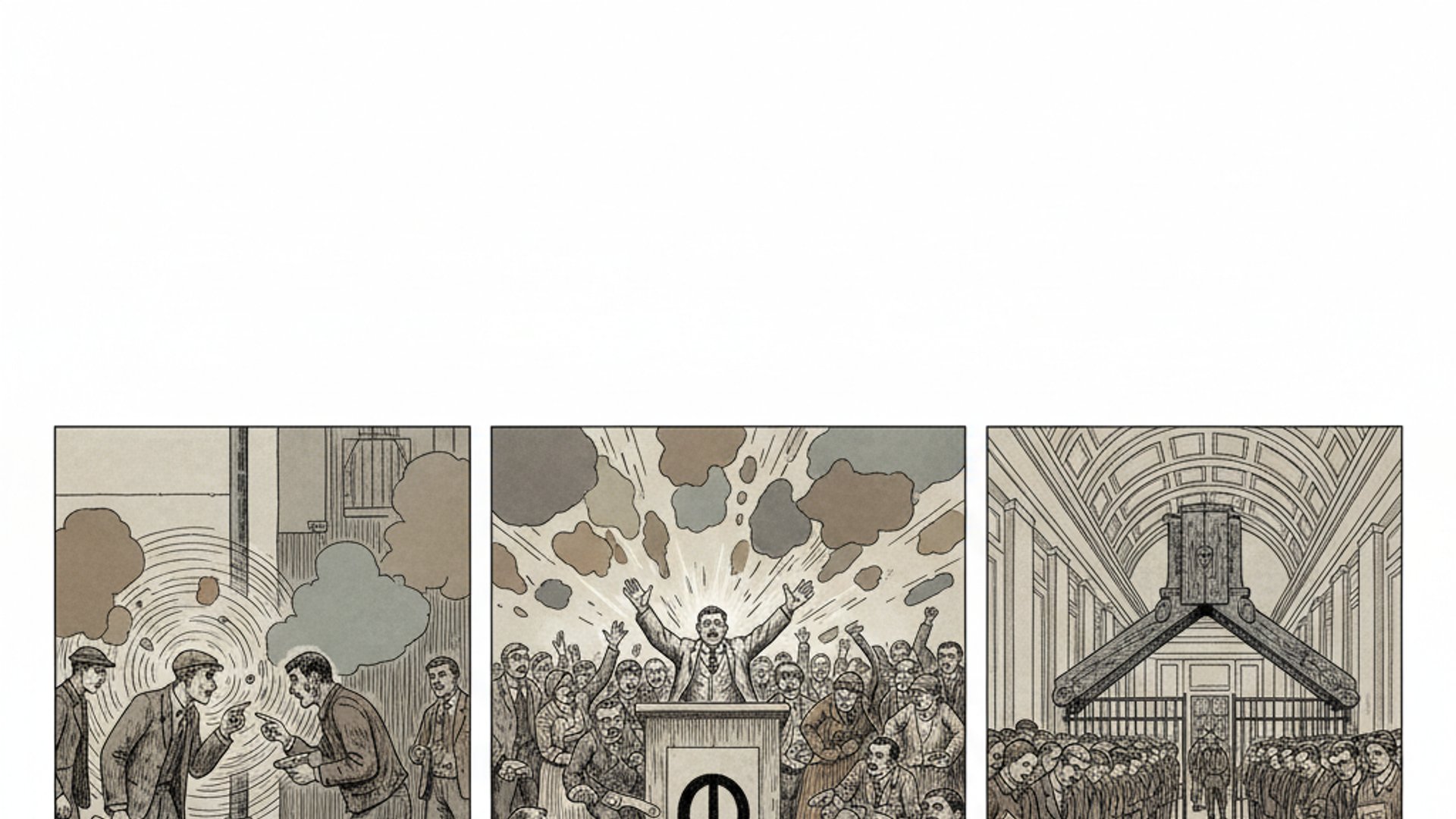
abels can act like trapdoors. Say a word and the floor drops. Among these, "anti-woke" has become a master switch: a device that shuts discussion before it begins, especially when the topic touches minority rights, history, or institutional power. This essay explains how debate-stoppers work—psychologically, rhetorically, and institutionally—then offers tools to disarm them in classrooms, newsrooms, and public forums.
The Switch in the Sentence
You walk into a room and raise a question about policing or school libraries. Before you reach the second clause, someone throws a label: woke—or, with more emphasis, this woke stuff. The label does not counter your claim; it dissolves it. Attention shifts from the substance to the stigma. The room exhales in relief: no need to think; the label has ruled.
Debate-stoppers win by speed. They fire before facts. They move the terrain from evidence to identity—What kind of person says this?—and the argument dies by classification.
A Short Anatomy of a Debate-Stopper
A debate-stopper, in its pure form, has five parts:
Trigger. A topic that implies redistribution of status or resources—race, gender, sexuality, migration, historical redress.
Label. A word that invokes moral panic: woke, ideological, politicized, agenda-driven.
Frame Shift. The conversation pivots from claim to character: you are not presenting evidence; you are performing an identity.
Social Signal. The label recruits allies by promising relief from discomfort. Listeners align with the team that "sees through" the performance.
Administrative Aftermath. An email: Given the climate, let's postpone/open a review/provide both sides. The postponement becomes the policy.
The stopper looks like skepticism. It is not. Skepticism asks for better reasons. The stopper abolishes the need for reasons at all.
Why the Brain Likes Labels
We conserve energy. Labels compress complexity into a single handle. Under uncertainty, the mind prefers handles to ladders. When a term also carries social meaning—signaling loyalty or rebellion—it binds the group while sparing members the labor of evaluation.
Add the joy of righteousness and you have a potent mix: identity, economy, and dopamine. The debate-stopper offers the cocktail in a single word.
From Tag to Tactic: The Rhetoric of Shortcutting
Debate-stoppers use several fast tricks:
Definition by Oscillation. The term shifts meaning as needed. When you provide a counterexample, the meaning slides away. The stopper never stands still long enough to be refuted.
Synecdoche of Scandal. One extreme anecdote stands in for an entire field. A clumsy training slide becomes the essence of antiracism; a loud activist defines all gender education.
Tone-policing Disguise. The speaker recodes urgency as aggression—You're being woke/ideological—so content never reaches the table.
Reversal of Victimhood. The labeler claims persecution by your "ideology," then demands balance that functions as erasure.
The goal is not to win an argument but to prevent one. The tactic thrives because it protects emotion from evidence.
Media Oxygen: How Debate-Stoppers Scale
Modern platforms amplify shortcuts. Headlines reward heat over proof. Social feeds rank frictionless content. Debate-stoppers are the perfect format: one word, maximal charge. They travel farther than footnotes and land with moral credit.
Television amplifies them with split screens: one voice for "woke excess," one for "free speech." The illusion of symmetry cements the label as a legitimate category. The audience learns the rhythm: speak a label, get a segment. Substance appears only as scenery.
Institutional Uptake: From Discourse to Policy
Labels change buildings. After enough segments and posts, administrators feel the draft under the door. They respond with policies that promise "balance," "age-appropriateness," "political neutrality." The words soothe; the procedures bite. Complaint portals bloom. Removal pending review becomes the default. Staff internalize the lesson: avoid the labeled topics.
No memo bans the subject. The building learns to walk around it.
Minority Rights Under the Stopper
Debate-stoppers hit hardest where the conversation already requires courage. A student wants a book about a queer teenager. A local museum proposes an exhibit on colonial extraction. A city council reviews stop-and-search data. The label appears, and the topic collapses into theater about the label. The minority in the room watches the floor open and learns a quiet rule: your story is discussable only after we finish debating whether we may discuss it.
This is how abstraction becomes exclusion. The stopper turns lives into categories and then debates the category instead of the life.
Recognizing the Move (A Field Guide)
You can spot a debate-stopper by three quick tests:
Does the response classify the speaker instead of addressing the claim? If yes, the label is working.
Does the response demand "balance" without specifying a method for weighing evidence? If yes, the label is setting quotas, not standards.
Does procedure appear immediately—review committees, postponements, parental forums—before anyone checks the facts? If yes, the label has jumped the queue.
When all three appear, you are not in a debate. You are in a performance of avoidance.
Counter-Moves: How to Reopen the Floor
Use tools that move the room from label to content.
Name the device. "That's a label, not a reason. What claim do you dispute?" Calm voice. No sarcasm.
Demand a method. "How shall we weigh evidence here? What counts as a strong source?" Put a ladder on the wall.
Specify stakes. "What decision rests on this? What harm follows if we're wrong?" Stakes convert theater into responsibility.
Clock the pause. "We can review, but materials remain available during review unless there's specific, imminent harm." Process protects curiosity.
Translate discomfort. "Discomfort isn't harm. Point to the sentence; we'll examine it." Protect people; examine ideas.
These moves do not inflame; they oxygenate.
The Classroom Kit
Teachers can preempt debate-stoppers by designing the room.
Wall Rules. Disagreement is a skill; safety is procedural; evidence has gravity; discomfort ≠ harm; change is the aim.
Twelve-Move Protocol. Frame, context, text, clarify, claims, steel-man, ladder, challenge, audit, synthesis, exit, archive.
Selection Rationales. Publish Why We Teach This briefs for each contested unit. The brief states aims, standards, and safeguards.
Complaint Process. Use signed, specific complaints; time-limit reviews; keep materials available unless imminent harm.
When a label arrives, the room already knows what happens next.
Newsroom Practice
Editors can dilute debate-stoppers without dulling coverage.
Headlines that name claims, not tribes. Replace "Woke Curriculum Sparks Outrage" with "District Reviews Unit on Racial Wealth Gap: Here Are the Sources."
Source ladders in sidebars. Show what counts as evidence and why. Teach readers to weigh, not to echo.
Refuse symmetry quotas. Do not seat a climatologist opposite a blogger for visual balance. Give asymmetry honest space.
Follow the decision, not the noise. Track what policies changed after a label campaign. Hold officials to reasons.
You can keep drama and raise IQ.
Civic Forums and Councils
When labels arrive at a school board or city council, the chair can keep the floor open.
Start with definitions. "Tonight we will hear claims and the evidence behind them. Labels without claims will be ruled out of order."
Require a written brief. Two pages: claim, evidence, stakes. No brief, no agenda slot.
Timebox and rotate. Keep speakers to a minute, rotate views, and forbid applause or booing. Sound consumes thought.
Publish outcomes with reasons. Record the decision and the standards applied. Sunlight deters slogans.
A meeting that respects time and reasons immunizes itself against performance art.
The False Friend: "We're Just Asking Questions"
The debate-stopper often dresses as curiosity. We're just asking questions. Real curiosity asks questions that can be answered and accepts answers that disappoint it. The false friend asks questions that multiply faster than answers and treats every reply as proof of evasion. The aim is not knowledge; it is corrosion.
Test the question with two probes: Is it falsifiable? What evidence would change your mind? If the answer to both is nothing specific, you are not in inquiry. You are in theater.
The Comfort Economy
Debate-stoppers sell comfort. They promise release from the strain of learning—the vertigo that comes when facts disturb identity. The promise feels humane. It is not. Comfort will gladly trade someone else's reality for your calm. The label smiles while it moves a book off a shelf.
Citizens must learn to bear a dose of discomfort the way sailors bear wind: as the price of movement. A society that avoids cross-currents ends up in a warm, still cove with no horizon.
Case Miniatures (Composites)
1) The Seminar that Became a Method Class. A lecturer proposes a session on migration stories and labor markets. The label appears: woke anthropology. The dean asks for a "methods-focused" alternative. The class learns about sampling error and never meets the people sampled.
2) The Panel that Lost Its Panelist. A museum invites a scholar of colonial trade routes. A donor utters woke revisionism. The invitation becomes a "future opportunity." The map on the wall keeps its blank corners.
3) The Book that Waited Forever. A parent files "age-appropriateness" concerns about a novel with a queer protagonist. The review, required to finish in 20 days, resets three times because holidays intervene. The term ends. No one banned the book. The year did.
These are not scandals. They are protocols.
The Ethics of Naming (Use with Care)
If labels wield power, should we ban them? No. We should use them honestly. Name a school policy "content removal pending review," not "protecting neutrality." Name a tactic a debate-stopper when it avoids claims. Refuse euphemism. Clean naming turns on lights.
Building Label-Resistance in Institutions
Institutions that resist debate-stoppers share three traits:
Clear principles, publicly stated. "We teach evidence-based curricula aligned with professional standards. We welcome questions about our methods and will answer with reasons, not removals."
Transparent processes that move faster than rumors. Publish syllabi in August. Respond to complaints within 20 days. Log decisions publicly. Speed and sunlight together kill fog.
Legal and social backing for staff. Indemnify teachers who teach within standards. Defend them loudly when labels appear. Courage requires insurance.
When leaders say these things in calm times, they can act on them when storms arrive.
What Students Learn When We Cave
When adults remove a book or defer a topic because a label appeared, students learn four lessons—none intended:
Ideas can be dangerous. Not because they're false, but because someone might be uncomfortable. The model is not inquiry; it is mood management.
Authority is fragile. Adults who cannot defend their choices lose credibility. Students stop trusting not the controversial material, but the teacher who wouldn't keep it on the shelf.
Discomfort equals harm. If we treat every hard topic as a threat, we train students to see friction as injury. They arrive at adulthood unable to sustain disagreement.
Some voices count more. The student who sees their life in the removed book learns a precise lesson about whose stories are optional.
These are not abstract costs. They are civic deficits that compound.
The Opposite of the Stopper
The opposite of a debate-stopper is not neutrality—it is rigor. Rigor names the claim, ranks the evidence, tests the reasoning, and admits uncertainty. Rigor is hard work. It requires reading, not reacting. It offers no shortcuts.
But rigor also offers dignity. It treats everyone in the room—including the minority voice, the uncomfortable question, the unfamiliar text—as capable of being examined rather than erased.
A rigorous classroom feels harder than a censored one. It is. It also produces citizens who can think under pressure rather than hide from it.
Why This Matters for Democracy
Democracies do not fail because people disagree. They fail because people stop practicing disagreement and start practicing avoidance wrapped in labels. When every contentious question gets postponed, reviewed, or balanced into paralysis, the public muscle for argument atrophies.
The debate-stopper is a small weapon with large effects. It trains a generation to equate controversy with contamination and comfort with truth. That training produces adults who can vote but cannot deliberate, who can choose teams but cannot change minds.
If we want a democracy that can handle the century ahead—climate, migration, automation, inequality—we need citizens who can argue through discomfort. We will not get them if we teach that labels are sufficient and evidence is optional.
Practical Summary: The Toolkit
When a debate-stopper appears:
Name it. "That's a label. What's the claim?"
Demand method. "How shall we weigh evidence?"
Specify stakes. "What decision depends on this?"
Clock the process. "We can review, but materials stay available unless there's specific harm."
Translate discomfort. "Show me the sentence; we'll examine it together."
Post these moves on walls, in syllabi, in board rules. Practice them in August so they're ready in March.
Conclusion
The debate-stopper promises relief: one word and the hard conversation vanishes. But the relief is borrowed against the future. Every time we let a label substitute for an argument, we make the next conversation harder and the room smaller.
The alternative is not comfort. It is competence: the ability to name a claim, weigh evidence, steel-man an opponent, and change your mind when the data shifts. That competence is learnable. It requires structure, practice, and institutional courage.
Debate-stoppers thrive in rooms that prize calm over truth. They wither in rooms designed for argument—rooms with protocols, transparency, and leaders willing to defend what they teach.
We can build those rooms. The tools are simple. The work is not. But the alternative—a democracy that cannot argue—is far more costly than the discomfort we're trying to avoid.
This article is part of the Sol Meridian Governance series, examining how institutions shape democratic capacity. Related essays: "Administrative Censorship," "Viewpoint Laws," and "Designing Disagreement."