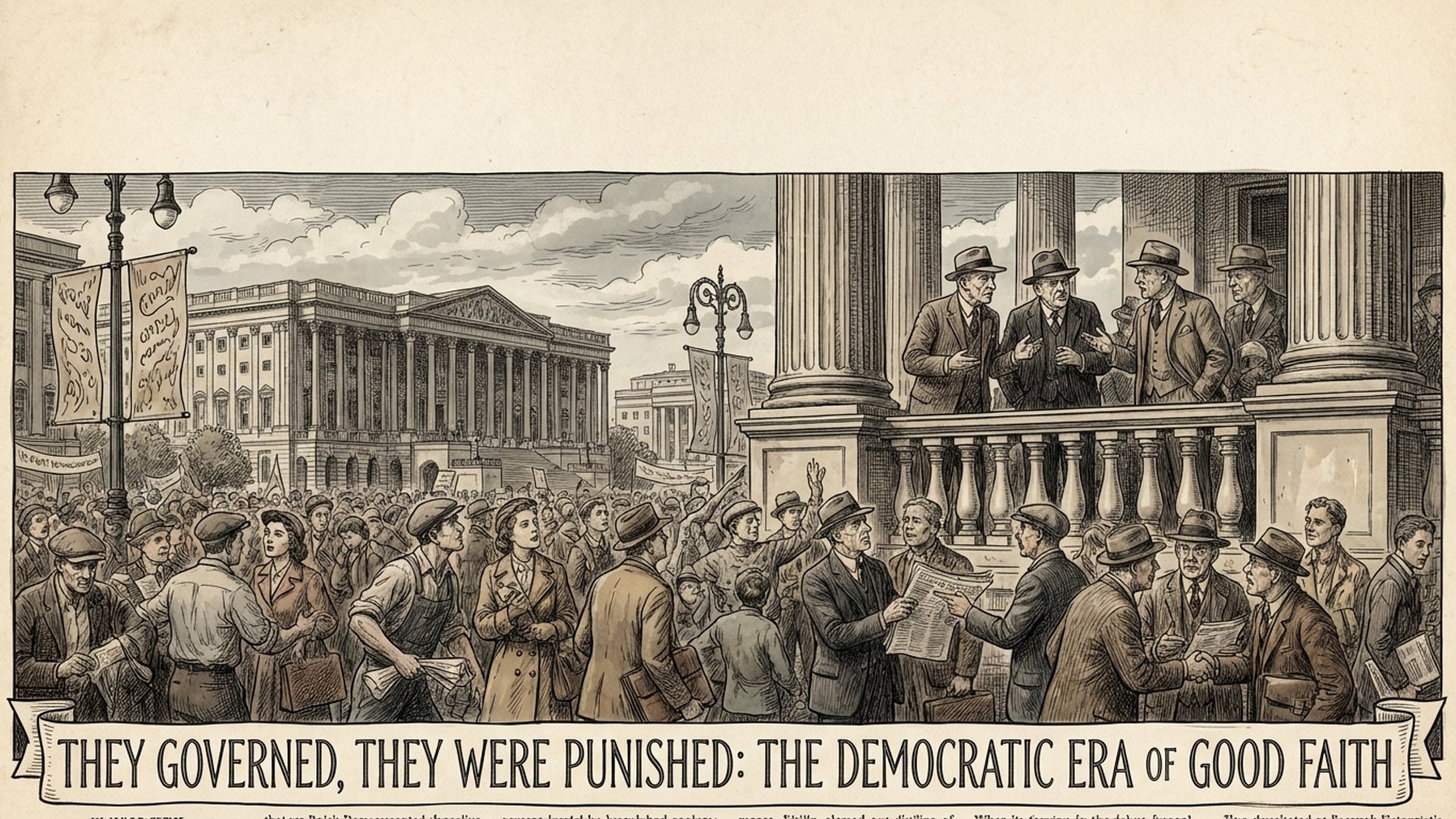
istory often turns on bargains people believe they are making with time. The last four Democratic presidents each tried to trade conciliation for legitimacy—compromise now for a common good later. They met, instead, a political ecosystem that increasingly rewarded maximal demands, informational fog, and procedural hardball. The result is a peculiar American chronicle: Democrats governing by stitching coalitions across the aisle, Republicans matching cooperation with escalation, and the press, too often, spreading a neutral cloth over an uneven table.
What follows is an examination of Jimmy Carter, Bill Clinton, Barack Obama, and Joe Biden through one lens: did bipartisanship function as a trap rather than a bridge? Along the way, we account for the second proposition: that these presidents, unlike their Republican counterparts, declined to criminally pursue the prior administration's misdeeds—sometimes because the law foreclosed it, sometimes because they believed the republic needed forward motion more than backward judgment. Where necessary, the record complicates the claim—especially in the present era, where the Justice Department has charged a former Republican president on grave counts. The pattern remains revealing even when it breaks.
This is not a morality play. It's institutional analysis set against a media environment that mistakes symmetry for fairness. In that terrain, restraint is lonely.
⸻
I. Jimmy Carter: Deregulation, Restraint, and the Vanishing Middle
Carter entered office after Gerald Ford pardoned Richard Nixon "for all offenses" he had committed or may have committed as president; that act legally closed the door on Watergate prosecutions of Nixon himself. Carter neither revisited it nor promised to. The wager was national repair. The pardon's text was expansive and final; any contrary theater would have been theater alone.
His governing approach was bargaining in the old congressional style: swap reforms across committees and produce mixed coalitions. Some of the era's most consequential changes—airline, rail, and trucking deregulation—were built with Republicans and market-oriented Democrats. The 1978 Airline Deregulation Act passed with wide support and reshaped the cost and structure of flying; the 1980 Staggers Rail Act freed freight carriers to set rates and abandon uneconomic lines; the 1980 Motor Carrier Act liberalized trucking. Each was sold as efficiency against inflation and stagnation, and each relied on cross-party votes that would have been impossible without Republican buy-in.
The foreign-policy bargain faltered. The SALT II treaty with the Soviet Union, signed but never ratified, was consumed by the Afghan invasion and domestic opposition; the Senate never voted it up, and the old détente grammar collapsed into a new rhetoric.
Carter's political image took a second blow from a label he never uttered. The "malaise" speech—his diagnosis of a crisis of confidence—did not include the word "malaise." The press pinned it there anyway, a reminder that framing can defeat text.
What did bipartisanship buy? Material reforms in logistics and aviation that endured for decades—but not an electoral coalition. The cross-pressured South migrated right; inflation, Iran, and the hostage crisis defined the public mood. Carter pardoned Vietnam-era draft evaders in his first month, a forward-looking leniency that cost him more support than it gained.
On the matter of "criminal accountability of prior Republican administrations," the record is straightforward: Ford's pardon mooted Nixon's exposure; there was nothing to pursue. Carter chose reconciliation over retribution in Vietnam matters and put his scarce capital into policy. The asymmetry came later.
⸻
II. Bill Clinton: Triangulation's Dividend and the Boomerang of Scandal
Clinton governed in a city remade by the 1994 Republican Revolution. His answer—"triangulation," defined and marketed by consultant Dick Morris—was to adopt pieces of Republican policy while advancing Democratic aims, presenting a third vector between left and right. It was a strategy built for daily survival, and it worked, until it didn't.
The bargains were huge. Welfare reform (PRWORA, 1996) passed the Senate 78–21 and the House 328–101; it fundamentally restructured cash assistance and embedded work requirements, the kind of legislation Democrats would later regret in its harsher state-level guises. The Balanced Budget Act of 1997 cleared the Senate 85–15 and helped produce late-1990s surpluses; it was the capstone to fiscal deals with a Republican Congress.
There was also DOMA—passed by veto-proof majorities (Senate 85–14; House 342–67) and signed by Clinton, later disavowed, ultimately struck down by the Supreme Court in 2013. Even here, the math tells the story: a Democratic president faced a coalition that could override him; he signed a bill he called "divisive and unnecessary" to avoid a politically suicidal veto that would fail. Compromise shielded little; history reversed the law anyway.
What did triangulation purchase? Balanced books, NAFTA's consolidation (and backlash), a tech boom's tailwinds. What did it cost? The power to set frames. Despite Clinton's concessions—crime bills, welfare reform, DOMA—Republicans escalated to impeachment over perjury and obstruction tied to a private affair. The House impeached on two counts (228–206 and 221–212); the Senate acquitted (45–55 and 50–50), but the asymmetry was stark: bipartisan governance met maximalist sanction.
On accountability for prior Republican administrations: Clinton inherited Iran-Contra's coda. President George H. W. Bush, in December 1992, pardoned Caspar Weinberger and five others, effectively foreclosing the independent counsel's path. Clinton did not attempt to relitigate that settlement; the legal and political ceiling had been nailed down before he arrived.
Clinton's signal lesson for Democrats was harsh: adopt a rival party's policy planks and you may still be tagged as illegitimate. The bargain—the old Beltway story about grown-ups meeting in the middle—did not inoculate against hardball.
⸻
III. Barack Obama: Governing in a Parliament Without Discipline
Obama inherited the worst downturn since the 1930s and a Republican Party already committed to negation. The Recovery Act (ARRA) passed the Senate with only three Republican votes (Collins, Snowe, Specter), and the House with zero. That lonely trio in the Senate soon shrank to two as Specter became a Democrat. The bargain, already threadbare, was measured in single digits.
The Affordable Care Act fared worse: zero Republican votes in the Senate (60–39, Christmas Eve 2009) and zero in the House (219–212). The party that had once authored the individual-mandate concept refused its own reflection, because the issue had ceased to be policy and had become power.
By October 2010, the Republican Senate leader said the quiet part aloud: "The single most important thing we want to achieve is for President Obama to be a one-term president." He later walked the phrasing back, but the posture told the tale.
The escalation continued. In 2016, Senate Republicans refused even to hold hearings on Merrick Garland, a moderate jurist nominated to replace Justice Scalia. The nomination simply expired—an unprecedented blockade in the modern era.
Meanwhile, filibusters and cloture motions multiplied. In the 1960s the Senate filed a few dozen cloture motions; in recent Congresses the count rose into the hundreds, transforming the supermajority into a daily requirement for routine governance. The numbers tell a structural story: rules built for comity became weapons of routine denial.
On accountability for the prior Republican administration, Obama chose restraint. Early in 2009 he said the nation should "look forward as opposed to looking backwards," declining to prosecute CIA personnel who acted under Office of Legal Counsel guidance in the torture program; by 2011–2012, DOJ had closed nearly all related investigations without charges. The 2014 Senate report memorialized the abuses; criminal liability remained untouched. The choice preserved political oxygen for health care and recovery; it also broadcast a lesson about impunity.
Pair this with Citizens United (2010), which supercharged outside spending and masked donors via 501(c)(4)s. Add the relentless "both sides" press reflex documented by political scientists Thomas Mann and Norman Ornstein, who called the GOP an "insurgent outlier" and criticized the media's false equivalence. You get an asymmetric parliament inside a separation-of-powers system—exactly the mismatch their work warned about.
The Obama paradox is therefore clean: compromise on stimulus yielded three Republican votes; legislate a market-based health system and receive none; nominate a centrist judge and face a blockade. The bargaining table tilted; the tablecloth read "fairness."
⸻
IV. Joe Biden: The Last New Dealish Liberal in a 50–50 Chamber
Biden began with a split Senate and a narrow House, and he treated legislation as an exercise in concrete arithmetic rather than bipartisan romance. Even so, he secured major bipartisan statutes: the Infrastructure Investment and Jobs Act (Senate 69–30; House 228–206), the CHIPS and Science Act (Senate 64–33; House 243–187), and the PACT Act for veterans exposed to toxins (Senate 86–11; House 256–174). These were not symbolic votes—they were large, complex bills passed under the old, difficult rules.
Where bipartisanship broke down, Democrats legislated alone: the Inflation Reduction Act passed on party lines (Senate 51–50; House 220–207), compressing climate policy, drug-price negotiation, and corporate minimum taxation into the one vehicle reconciliation allowed.
On accountability for the prior administration, the pattern changes. Under Biden, the Justice Department appointed an independent special counsel and charged Donald Trump in two federal cases: one concerning attempts to overturn the 2020 election and obstruct the transfer of power (four felony counts), the other concerning retention of classified documents and obstruction (dozens of counts). Whatever else one says about prosecutorial restraint as an ethos, this is not a story of looking away.
There is a wider paradox here. Biden's bipartisan laws—roads, chips, veterans—are popular in the abstract; the party-line climate law is measurable in factory construction and clean-energy buildout. Yet the media diet is saturated by spectacle, and the nation's most famous political figure is a man whose false or misleading claims topped 30,000 during his first term, a cadence that corrodes the very possibility of shared fact.
Biden has tried to be the last practitioner of the old art—committee chairs at the table, a bill amended into being—while standing inside an information environment that rewards the opposite. He can pass laws with Republicans, and he has; he cannot make the post-truth incentive vanish.
⸻
V. Were They "Victims" of Bipartisanship?
Carter traded with policy conservatives long before it was fashionable for Democrats to praise markets. He won lasting structural reforms, but he did not win narrative ground. His greatest political wounds were not from compromise but from events (inflation, Tehran) and from a media frame that mistook diagnosis for despair. The relevant asymmetry was about perception.
Clinton proved that adopting the other party's program does not obligate the other party to treat you as legitimate. Triangulation yielded budgets and bipartisan vote tallies—and impeachment. The logic of mutualism did not hold.
Obama tried genuine outreach against a party whose leadership publicly prioritized his defeat and embraced procedural brinksmanship. When he did the "reasonable Republican" thing—health insurance via regulated markets—he got zero Republican votes. The Garland blockade placed a granite slab over the old comity. In his case, bipartisanship functioned less as a trap than as a mirage: it meant building the bridge yourself and discovering no one on the far bank.
Biden has had the most success extracting concrete gains from a handful of Republican votes while accepting that further ambitions would demand party unity alone. Here, bipartisanship was transactional rather than talismanic; when it cleared the bar (infrastructure, CHIPS, veterans), it delivered. When it couldn't (climate, drug pricing), Democrats went alone.
Conclusion on the proposition: Yes, across forty-plus years, Democratic presidents disproportionately pursued cross-party bargains; Republicans, faced with the same overtures, often escalated. Where Democrats practiced restraint on criminal accountability, the reasons varied: Ford's pardon precluded action for Carter; Bush's Iran-Contra pardons foreclosed much under Clinton; Obama made a prudential (and contested) decision to "look forward" on torture and post-Iraq-war accountability; Biden's DOJ, by contrast, has moved on alleged crimes tied to an attempted subversion of constitutional order. The pattern is thus three instances of restraint followed by one of enforcement, underlining that the "never prosecute" claim cannot stand as a general law.
⸻
VI. The Media's Flat Mirror
The press's ideal of neutral observation can distort when the system itself is asymmetric. Mann and Ornstein said it plainly in 2012: the GOP had become an "insurgent outlier," and journalists' "he said, she said" defaults created a false balance that hid the reality of procedural and ideological radicalization. Jay Rosen's critique—the "view from nowhere"—isn't a call for partisanship; it's a demand that evidence be weighted rather than averaged. The case of climate coverage is notorious: decades of "both sides" treatment imparted a sense of controversy where the science was robust. Politics followed the misperception.
Against that mirror, Carter's "malaise," Clinton's scandals, Obama's imagined moderation, and Biden's trudging legislative successes land as equivalent episodes on a news crawl. They are not: one set contains negotiated power plants, bridges, semiconductors, veterans' care, and the largest climate bill in U.S. history; the other contains maximal opposition and, in the last decade, the daily industrialization of falsehoods.
⸻
VII. Responsibility Without Reciprocity
The deeper problem is architectural. The U.S. constitutional order was designed for factions, not parties disciplined like parliamentary blocs. When one party behaves as a "winner-take-all" parliamentary force inside a supermajority-bound Senate, the result is gridlock on demand—and incentive to claim that government cannot work. Cloture statistics show the mechanization of this tactic across decades.
Bipartisanship cannot thrive when one side treats cooperation as a public-relations asset and obstruction as a governing method. Add outside money and donor-advised conduits post-Citizens United, and the system pays handsomely for the appearance of civic virtue while delivering the substance of veto. (Dark-money infrastructure and platform politics are separate essays in your series; they form the river in which these boats drift.)
Under such rules, Democrats' restraint on accountability read as weakness rather than strength. Pardons closed books; "look forward" became "never mind." And yet the Biden years point toward an alternative equilibrium: bargain when the math works, use party-line rules when it doesn't, and let independent prosecutors handle crimes without White House micromanagement. It's messy, but it reintroduces consequences into a system that had forgotten them.
⸻
VIII. A Short Ledger of Lessons
-
Compromise is a method, not a virtue. Carter and Clinton used it to write durable law; Obama found it unavailable; Biden repurposed it as a tactical instrument. Treating bipartisanship as a good in itself invites exploitation.
-
Accountability cannot be ceremonial. Ford's and Bush's pardons ended investigations; Obama's restraint on torture prosecutions traded legal closure for legislative bandwidth. Biden's DOJ breaks the pattern—whatever the outcomes, the act of charging restores a precedent: no one is immune if evidence warrants.
-
The press must weight evidence, not average it. A politics that produces 30,000+ false claims from one figure in four years is not symmetrical with one that does not. To treat them as such is to abandon the public to noise.
-
Reform the rules or live by them. As long as the Senate's supermajority logic can be invoked for nearly everything, governance will require either sweeping electoral wins or a dual strategy: bipartisan where possible, reconciliation where necessary. The data has already described this world.
-
Narrative is a branch of power. "Malaise" without the word; "triangulation" without protection; "post-partisan" without partners; "Sleepy Joe" with factories rising—none of these are merely reputational skirmishes. They shape which policies survive their news cycles.
⸻
IX. Coda: Distance and Light
A historian's duty is less to scold than to measure. The record shows four Democratic presidents who, in different proportions, attempted to govern a Madisonian republic with a parliament's opposition; who often chose restraint where retaliation was available or at least demanded by their base; who were sometimes repaid with suspensions of reciprocity. The asymmetry is not a fable. It is legible in vote counts, in rules abused, in hearings denied, and in a cascade of public falsehoods that made trust a scarcer currency than oil.
The larger remedy is neither cynicism nor naïveté. It is institutional. If the press resists false balance and reports proportional truth; if voters reward measurable outputs over permanent campaign; if Congress trims the procedural hedges it grew for shade and now uses for siege; if prosecutors follow evidence rather than winds—then the old bargain might be reborn as something sturdier than nostalgia.
Until then, bipartisan scenes will continue to look like what they have become: not a meeting of equals across a middle, but a provisional truce in a war one side denies exists and the other side denies is winnable.
⸻
Notes & key sources
- Miller Center, University of Virginia: Carter's "Crisis of Confidence" address and the "malaise" misnomer; Vox explainer on the myth
- Brookings Institution: Airline deregulation's origins and Carter-era bipartisan reform
- Federal Highway Administration & U.S. BTS: Staggers Rail Act (1980) and Motor Carrier Act (1980) context and effects
- Encyclopædia Britannica: SALT II signed, not ratified, after the Soviet invasion of Afghanistan
- Presidential Proclamation (Ford, 1974): Pardon of Richard Nixon—legal implications for later administrations
- U.S. Senate / House records: Welfare reform (PRWORA) and Balanced Budget Act of 1997 vote counts
- Congress.gov; The Guardian/WaPo/Wired: DOMA passage, later struck down (Windsor, 2013)
- U.S. House Clerk / Senate records; Miller Center: Clinton impeachment votes and acquittal
- National Archives reporting; contemporary coverage: Bush's Iran-Contra pardons (Dec. 1992)
- Senate & House records; PolitiFact: ARRA votes (three GOP senators; zero House Republicans)
- Senate roll calls & historical tables: ACA votes; filibuster/cloture statistics over time
- McConnell's "one-term" formulation (2010) and Garland blockade (2016)
- DOJ/Holder decisions; reporting on torture investigations closed without charges
- Mann & Ornstein on asymmetric polarization; CJR and Brookings on media false equivalence
- Jay Rosen's "view from nowhere" (public media critique)
- Infrastructure Investment and Jobs Act votes (Senate 69–30; House 228–206)
- CHIPS and Science Act votes (Senate 64–33; House 243–187–1)
- Honoring our PACT Act votes (Senate 86–11; House 256–174)
- Inflation Reduction Act votes (Senate 51–50; House 220–207)
- Special Counsel charges against Donald Trump (election subversion; classified documents)
- Washington Post Fact Checker: 30,573 false or misleading claims by Trump over four years